Blog
Finance and Trade: Moving From Volume to Value
Hong Kong Maritime Week 2026 opens today, with a series of events taking place on both sides of Victoria Harbour. Tomorrow, Hong Kong Exchanges and Clearing Limited (HKEX) will hold a launch ceremony in Central for its Offshore RMB Bond Index. While these two events may appear to focus on different subjects, they point to the same trend: Hong Kong's financial and trading sectors are moving beyond rapid growth in volume towards creating greater value.
Let us begin with finance. Issuance of offshore renminbi (RMB) bonds in Hong Kong, commonly known as "dim sum bonds", has grown rapidly this year. In the first three quarters alone, dim sum bonds accounted for 38% of the total issuance value of bonds listed in Hong Kong, overtaking US dollar-denominated bonds for the first time and making the RMB the largest currency of issuance in Hong Kong's listed bond market. The issuer base is also becoming increasingly diverse. From Mainland technology companies to overseas governments and financial institutions, more issuers are turning to dim sum bonds as an important financing channel.
|
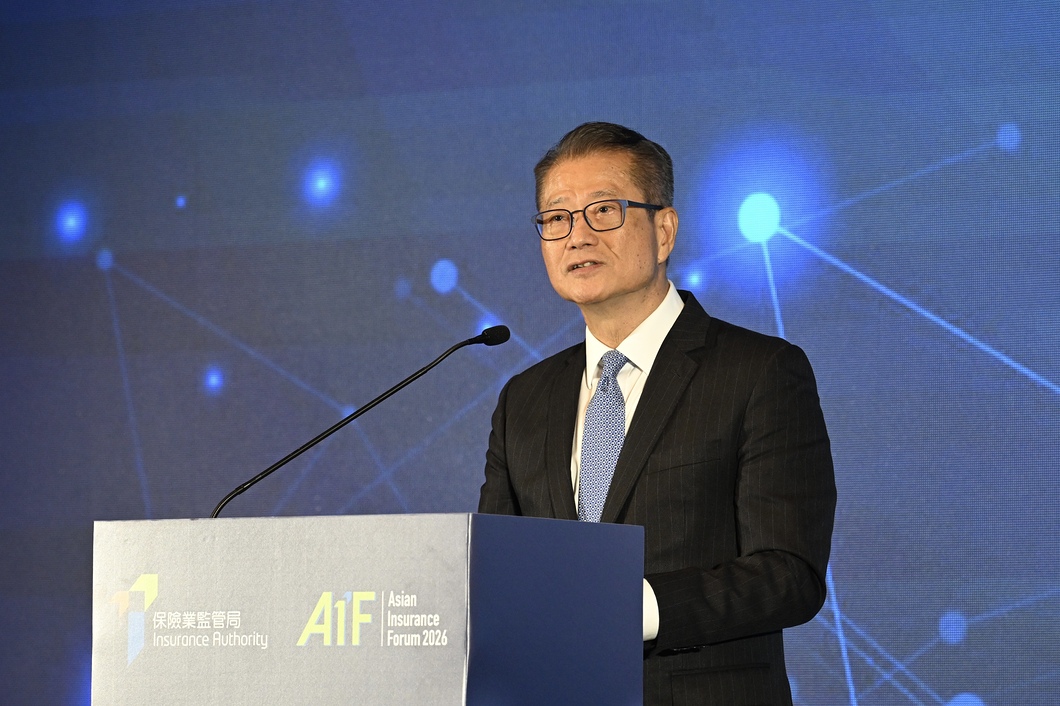
| Speaking at the Asian Insurance Forum 2026 last week. |
Hong Kong's offshore RMB ecosystem has already achieved considerable scale. Around three-quarters of global offshore RMB payments are processed through Hong Kong, while annual cross-border RMB trade settlement has exceeded RMB10 trillion for four consecutive years. Our RMB liquidity pool stands at around RMB1.3 trillion, and annual dim sum bond issuance has reached RMB1 trillion for two consecutive years. Outstanding offshore RMB loans reached a record RMB935 billion last year and exceeded RMB1.1 trillion in September this year, representing year-on-year growth of more than 20%. The HKSAR Government issues RMB bonds regularly, while the Ministry of Finance also issues bonds in Hong Kong each year, providing a steady supply to the market.
As the market grows, it needs a benchmark suited to its development. HKEX's forthcoming Offshore RMB Bond Index will provide a Hong Kong-based benchmark for the expanding dim sum bond market. As HKEX's inaugural bond index, it will comprise more than 300 offshore RMB bonds listed in Hong Kong. This benchmark will enable fund managers to develop more passive investment products, including exchange-traded funds and other index-tracking funds, while giving international investors a clear reference for allocating capital to RMB assets. In recent years, Bond Connect and Swap Connect have continued to grow in scope and depth. China government bond futures were launched this August, and the Hong Kong Monetary Authority (HKMA) has expanded its RMB Business Facility to RMB500 billion. Tomorrow's index launch will add another important piece to this ecosystem.
Viewed more broadly, this development is also part of a changing global financial landscape. Geopolitical tension and rising protectionism are pushing businesses and investors to diversify, both in where they invest and in the currencies they use. According to the Society for Worldwide Interbank Financial Telecommunication (SWIFT), the RMB accounted for 3.33% of global payments in September, ranking fifth among all currencies. China is the world's largest merchandise trading nation, and the share of its goods trade settled in RMB has risen steadily, from around 18% in 2022 to nearly 30% in the first half of this year. Ultimately, the wider use of offshore renminbi is driven by the needs of the real economy. With around 80% of global trade carried by sea, this also underscores the importance of Maritime Week, which opens today.
Now in its tenth edition, this year's Maritime Week carries the theme "Trusted Resilience Powering Global Maritime Trade". Over seven days, more than 80 organisations from Hong Kong and around the world will host over 60 events, expected to attract more than 18,000 industry participants worldwide in person. To mark this 10th anniversary milestone, we will announce a new group of partner ports and sign a number of maritime-related memoranda of understanding.
In fact, global trade patterns are evolving continuously. In the first ten months of this year, trade between the Chinese Mainland and ASEAN grew by 24% to around RMB7.7 trillion. In the first half of the year alone, intermediate goods, including parts and components, accounted for around two-thirds of their bilateral trade. This suggests that supply chains are not simply being "relocated"; they are "extending" across borders. As goods pass through more ports, the reliability and efficiency of each become increasingly important. At the same time, the green transition and artificial intelligence are reshaping the maritime industry. Orders for alternative-fuelled vessels rose by nearly 60% year on year in the first ten months of this year, yet only around 25 ports worldwide can provide methanol bunkering services. Supporting infrastructure clearly has considerable ground to make up.
These developments present opportunities for Hong Kong to move from volume to value as an international maritime centre. Our focus extends beyond container throughput to the full range of high value-added maritime services, from ship finance, marine insurance and ship management to fuel supply, mediation and arbitration. Hong Kong's port operates with exceptional efficiency: ocean-going container vessels spend an average of only about one day here, roughly half the average at major ports worldwide. This makes Hong Kong an important "catch-up port", helping vessels recover time lost elsewhere. Our goal is to translate this operational efficiency into a broader advantage in maritime services.
|
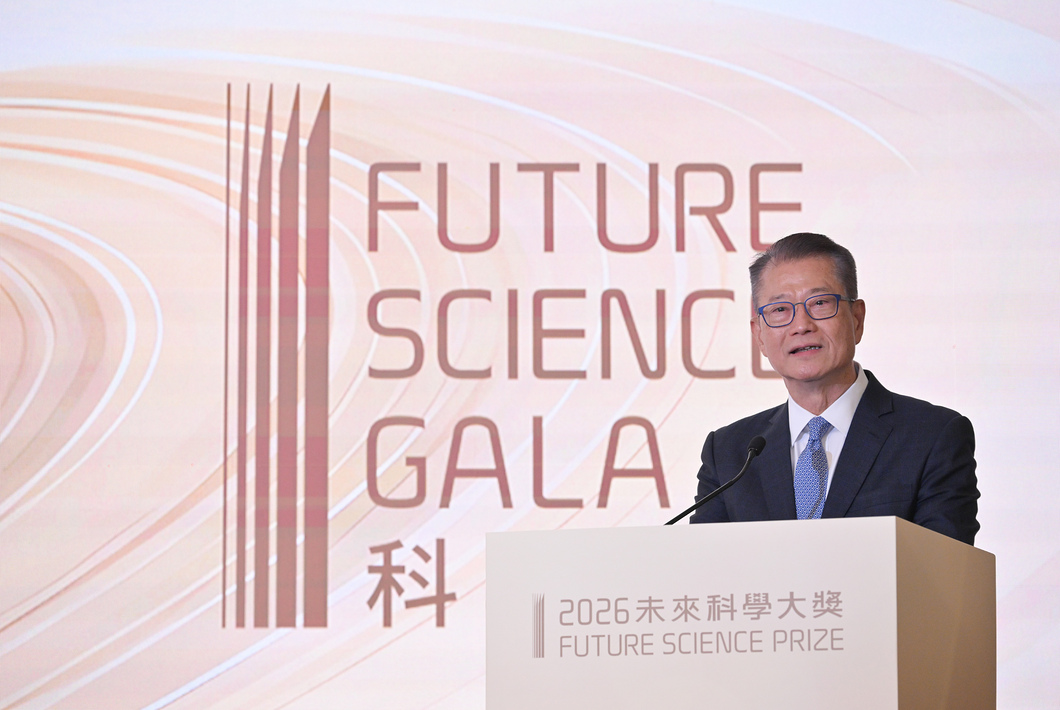
| Attending and speaking at the Future Science Prize Science Gala Dinner last week. |
In aligning standards, port partnerships connect individual ports into a wider network. Last year, we established partner-port relationships with Dalian, Guangxi and the Port of San Antonio in Chile. Last month, we forged a brother-port relationship with Shanghai, and a new group of partner ports will be announced shortly. As this network expands, closer alignment of data, fuel standards and contingency arrangements at both ends of shipping routes can enhance port efficiency and facilitate trade.
In technology adoption, data is key to greater efficiency. Since its launch earlier this year, Hong Kong's Port Community System has attracted registrations from more than 10,000 enterprises. Under the HKMA's Project CargoX, 21 banks are using trusted cargo data to expedite trade finance approvals, and the project is beginning to extend to the Yangtze River Delta. The more smoothly data flows, the more efficiently goods move and trade finance can be provided.
Green shipping offers another new avenue for growth. Since the publication of the Action Plan on Green Maritime Fuel Bunkering in November 2024, vessels have taken on more than 380,000 tonnes of green maritime fuels in Hong Kong, including liquefied natural gas, biodiesel and green methanol. Leveraging the country's position as the world's largest producer of green maritime fuels, we are developing a model of "production in the Chinese Mainland, bunkering in Hong Kong, serving the world", with the aim of building an international green maritime fuel bunkering and trading centre.
Finance and trade have always reinforced each other. Trade gives finance purpose; finance carries trade further. In a world that is increasingly fragmented, Hong Kong's role as an open and trusted "super-connector" matters more than ever, for finance and for maritime trade alike. And as we move from growing volume to creating value, Hong Kong will find ever wider ways to serve our country and contribute to global development.
November 15, 2026