Blog
Reinforcing Connectivity with the Mainland and the World
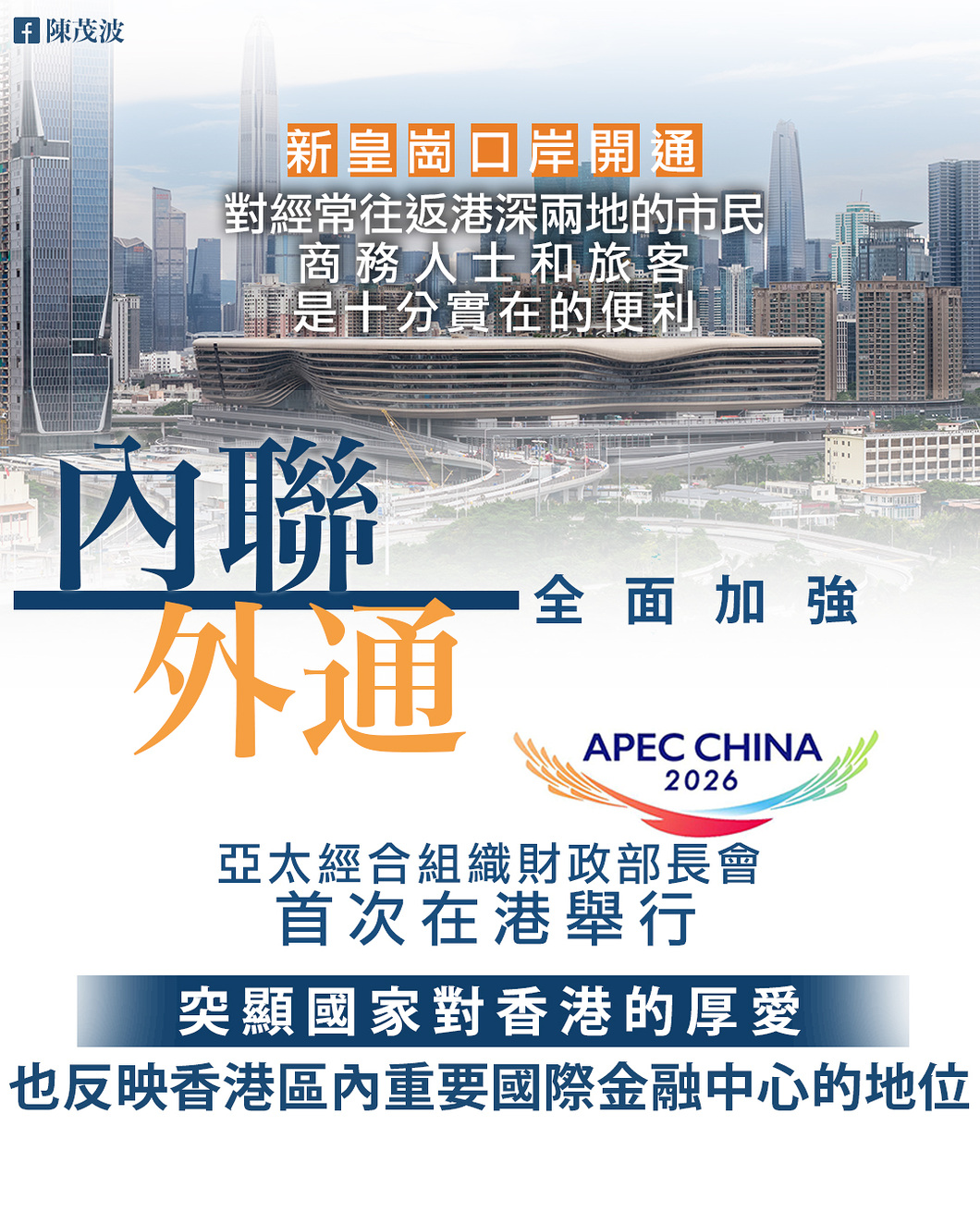
Having served for more than three decades, the Lok Ma Chau Control Point completes its historic mission today. Tomorrow, the new Huanggang Port will continue to serve this Hong Kong–Shenzhen corridor with upgraded facilities. With a total gross floor area of approximately 690,000 square metres, the new port's joint inspection building is the world's largest single-building land boundary control facility. It is designed to handle 200,000 passenger trips daily—five times the design capacity of the old port. Under the "collaborative inspection and joint clearance" arrangement, travellers will be able to complete immigration procedures for both sides in approximately five minutes, down significantly from around 30 minutes at the old port. Round-the-clock clearance will be maintained. For residents, business travellers and visitors who regularly travel between Hong Kong and Shenzhen, this will make their journeys much more convenient.
As new infrastructure strengthens our connections with the Mainland, a major international event will also reinforce our links with the wider world. In just over a week, Hong Kong will host the Asia-Pacific Economic Cooperation (APEC) Finance Ministers' Meeting for the first time. Finance ministers and representatives from economies across the region will gather here to explore how fiscal policy and financial services can strengthen regional economic ties.
|
APEC's 21 member economies have a combined population of around three billion and account for more than 60% of global GDP. Hong Kong, China, is a member economy and has long played an active role in APEC's work. Trade with fellow APEC economies accounts for 87% of Hong Kong's total external trade, underscoring the importance of the Asia-Pacific region, where our most active markets are located. The decision to hold the Finance Ministers' Meeting here demonstrates our country's strong support for Hong Kong and reflects our standing as a major international financial centre in the region.
The global economic environment is fraught with uncertainty. The United Nations Conference on Trade and Development's newly released Trade and Development Report 2026 projects that global economic growth will slow to 2.6% this year, down from 2.9% last year. Geopolitical tensions, energy and supply chain risks, and tightening financial conditions are putting pressure on economic development around the world. How economies can strengthen cooperation, sustain growth and safeguard people's livelihoods will be a key question at this Finance Ministers' Meeting.
This is the "APEC China Year", with the theme "Building an Asia-Pacific Community to Prosper Together" and three priorities: "openness, innovation and cooperation". The Finance Ministers' Meeting will focus on four areas: fiscal policies that support people's livelihoods, financing for digital infrastructure, financial inclusion, and exchanges and cooperation among young talent in economics and finance. These priorities are aimed at safeguarding livelihoods, boosting productivity, supporting small and medium enterprises (SMEs), and nurturing the next generation. Regional cooperation matters directly to businesses, the public and young people.
All four priorities align with Hong Kong's strengths and offer opportunities for us to contribute actively. Take the mobilisation of long-term capital for the region's low-carbon transition, for example. Green and sustainable debt issued in Hong Kong totalled more than US$76 billion in 2025. Of this, green and sustainable bonds arranged in Hong Kong accounted for around US$38 billion, placing us first in Asia for the eighth consecutive year. Projects across the region need funding, while investors need transparency. Hong Kong is well placed to connect the two through our strengths in green bonds, transition finance, project certification and professional services, etc.
Digital infrastructure is another area with substantial financing needs. The development of artificial intelligence is driving investment in computing power, data centres and cloud services. These projects are large in scale and subject to rapid technological change, making it essential to balance commercial viability with fiscal sustainability. Hong Kong can promote greater exchange and collaboration among APEC member economies, bringing together governments, financial institutions, investors and technology companies across the region to explore public-private financing models. Public resources can play a guiding role in attracting more private capital to support the region's digital economy and AI development, helping to accelerate growth in real economies across the region.
Hong Kong also continues to promote financial inclusion, extending the benefits of financial services to more businesses and individuals. The Hong Kong Monetary Authority's Commercial Data Interchange is one example. SMEs can authorise banks in advance to access their operational data from different sources, improving the efficiency of loan approvals and helping to ease financing difficulties. By the end of June this year, the platform had facilitated more than 108,000 loan applications, with approved credit totalling nearly HK$90 billion.
The fourth priority of the Finance Ministers' Meeting concerns exchanges and cooperation among young talent in economics and finance across the region. This is an area we have long championed. Hong Kong's regulators and financial institutions offer a range of programmes, from training and internships for students to professional development and exchange opportunities for young people already in the workforce. Through our talent development initiatives in green finance, asset and wealth management, and fintech, we hope to help young people better understand regional markets and emerging business areas. Notably, more than 150 young volunteers will help welcome guests at this meeting. While helping the event run smoothly, they will have opportunities to interact with government and business leaders and see first-hand how an international conference is run. This will be a valuable learning experience beyond the classroom, while also giving our guests a sense of the enthusiasm and friendliness of Hong Kong's young people.
Beyond contributing to the meeting's agenda, Hong Kong will also actively showcase its strengths and promote the role of finance in accelerating regional development. Our capabilities extend beyond fundraising and financing: Hong Kong is also an international insurance and risk management hub. Our insurance-linked securities services, captive insurers and dedicated maritime risk pools offer opportunities for cooperation with regional partners. Catastrophe bonds and specialised risk underwriting can also provide additional protection and financing tools to support infrastructure investment and help address climate risks across the region. These capabilities open up broader markets for Hong Kong's financial, insurance and professional services sectors.
The APEC Finance Ministers' Meeting is an international gathering that attracts global attention and one of Hong Kong's major world-class events. Beyond attending the meeting, visiting financial officials, business leaders and other guests will have the opportunity to learn about Hong Kong's progress in innovation and technology, as well as urban development, while experiencing the vibrancy and appeal of our arts and culture. From the world's top-ranked bar and best hotel to a diverse range of cuisines and picturesque countryside, Hong Kong has attractions at every turn. We warmly welcome guests from around the world to explore and experience all that the city has to offer.
October 11, 2026