Blog
A New Chapter for the Belt and Road: Hong Kong's Growing Contribution
The International Monetary Fund's latest global macroeconomic projections, released a few months ago, forecast growth of 3.8% and 4.5% for emerging market and developing economies this year and next year respectively—well above the rates for both the global economy and advanced economies. Indeed, emerging markets have been growing at a relatively faster pace for a quarter of a century.
This sustained growth has fuelled demand for consumer goods and infrastructure in emerging markets. The progressive relocation of Mainland industrial chains to Belt and Road regions is a response to these expanding opportunities. Mainland enterprises have now established around 58,000 companies overseas, creating more than 2 million local jobs each year. Their outward investment stock has reached US$3.4 trillion, with nearly 90% in developing economies. Market demand is shaping the location of industrial chains, while economic growth is drawing in capital. The direction of trade and investment is clear, with vibrant flows in both directions—and Hong Kong stands at their intersection.
|
Over the past five years, Hong Kong's merchandise trade with ASEAN, the Middle East and Central Asia has grown by an average of nearly 10% a year, with these markets' combined share of the city's total merchandise trade rising to about 17%. ASEAN has remained Hong Kong's second-largest trading partner since 2010. On the investment front, Hong Kong's direct investment in ASEAN reached US$16.5 billion last year, an increase of nearly 140% from five years earlier, accounting for almost 7% of ASEAN's total foreign direct investment inflows.
On the business front, the number of companies from ASEAN and the Middle East with a presence in Hong Kong has also exceeded 930, up nearly 30% from five years ago. A survey by the Hong Kong Trade Development Council shows that Hong Kong is the preferred platform for overseas expansion for the vast majority of Mainland enterprises seeking to enter Belt and Road markets.
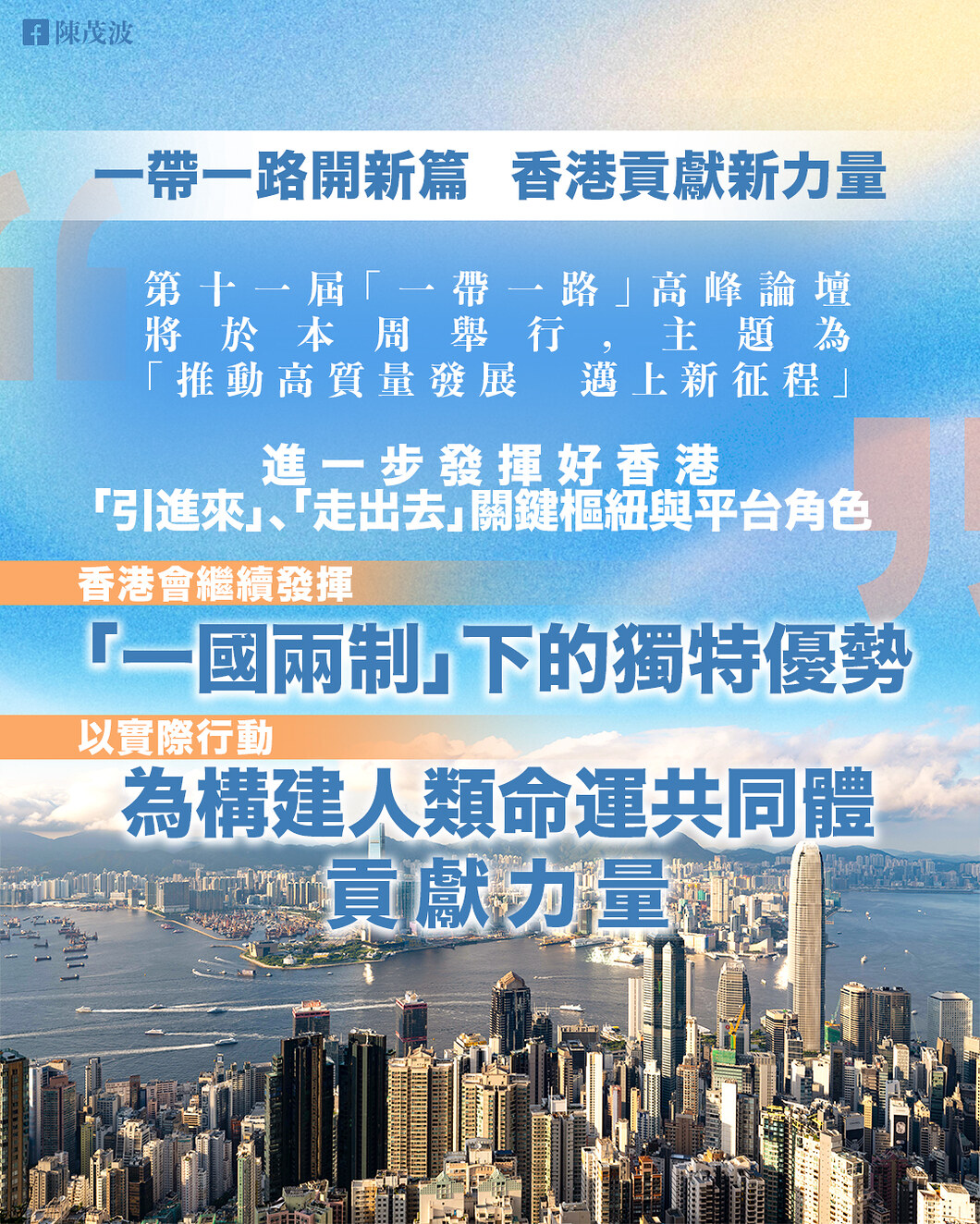
Whether it is facilitating inward investment or supporting overseas expansion, Hong Kong serves as a key hub for accelerating development and deepening exchanges. The 11th Belt and Road Summit, to be held in Hong Kong this week, will further strengthen this role. Under the theme "Advancing High-Quality Development • Embarking on a New Journey", this year's summit will introduce a dedicated "Go Global Chapter" for the first time, offering further support to Mainland enterprises expanding overseas. It will also focus on energy, artificial intelligence, the low-altitude economy and urban development, with site visits providing additional opportunities for exchanges and collaboration that benefit businesses and markets on both sides.
Hong Kong's strengths and experience in financial services also play a vital role in accelerating regional development and strengthening cooperation. In infrastructure financing, for example, the Hong Kong Mortgage Corporation has launched three rounds of infrastructure loan-backed securities in recent years. These draw market capital into mature projects, freeing up funds for new ones. Together, the securities cover dozens of projects worldwide and have a total value exceeding US$1.2 billion, enhancing liquidity for infrastructure projects in the region.
In equity financing, more than 100 enterprises from Belt and Road regions are currently listed on Hong Kong's stock exchange, with a combined market capitalisation of over HK$340 billion. A state-owned infrastructure company from Central Asia is also planning to list in Hong Kong. In bond financing, issuers from Belt and Road regions had, as of July this year, issued 82 listed bonds in Hong Kong, raising more than HK$470 billion. In recent years, governments, public bodies and enterprises from Southeast Asia, Central Asia and the Middle East have tapped Hong Kong's offshore Renminbi (RMB) bond market, also known as the "dim sum bond" market. The Indonesian Government, for example, issued approximately RMB 9.25 billion in dim sum bonds in February this year. In August, a Kazakh oil and gas company issued approximately RMB 3.5 billion in dim sum bonds in Hong Kong—the largest such issuance by a Central Asian enterprise in the city.
Sovereign wealth funds from the Gulf region also continue to expand their presence in Hong Kong. A major international bank from a Gulf country will officially open a representative office here this week, while that country's sovereign wealth fund partnered with a local fund last year to launch an energy transition fund. These developments further reinforce Hong Kong's role as a destination for long-term capital and a platform for expanding business across the Asia-Pacific region.
The development of trade and capital markets requires a robust institutional framework. As RMB's share of regional trade financing continues to rise, Hong Kong—the world's largest offshore RMB hub—is providing reliable support for greater currency diversification in regional trade. With strong support from the People's Bank of China, the total quota under Hong Kong's RMB Business Facility (RBF) has been further expanded to RMB 500 billion. Bank Indonesia, the Hong Kong Monetary Authority and the People's Bank of China have also signed a memorandum of understanding to facilitate direct settlement in Indonesian rupiah and offshore RMB between businesses and institutions in Indonesia and Hong Kong. This will significantly reduce businesses' foreign exchange costs.
We aim to further support Belt and Road enterprises in entering new markets and reducing transaction costs, helping to unlock the region's growth potential. Hong Kong has signed comprehensive avoidance of double taxation agreements with 43 Belt and Road tax jurisdictions, while its investment agreements and free trade agreements cover 20 and 14 economies respectively. Established last year, the GoGlobal Task Force has helped more than 300 Mainland enterprises set up or expand their operations in Hong Kong. By bringing together institutional support, capital and high-growth services, we are making regional collaboration and market connectivity faster, more tangible and more efficient.
Looking ahead, artificial intelligence and the green transition are widely recognised as key priorities for future development. To foster exchanges and deepen cooperation, the Government has established the Hong Kong Green Technology Innovation Centre Limited to advance green technology research, development and application, environmental certification, talent development and international cooperation. A green technology project accelerator, spearheaded by a local think tank and supported by a number of Mainland and international financial institutions, will also be launched soon to support the green transition in Belt and Road regions. The Hong Kong Monetary Authority updated the Hong Kong Taxonomy for Sustainable Finance this year, providing clearer guidance for the region's low-carbon transition. This week, we will also co-host a climate finance conference with the Dubai Financial Services Authority. Through these initiatives, Hong Kong is bringing its combined strengths in green technology and green finance to support regional development.
Hong Kong will continue to leverage its unique advantages under the "one country, two systems" framework. From advancing infrastructure projects that strengthen "hard connectivity", to aligning rules and standards through "soft connectivity", and bringing people closer together through people-to-people bonds, we will take concrete action to contribute to building a community with a shared future for mankind.
September 6, 2026