Blog
Fast-tracking Development of the Northern Metropolis through Market Forces
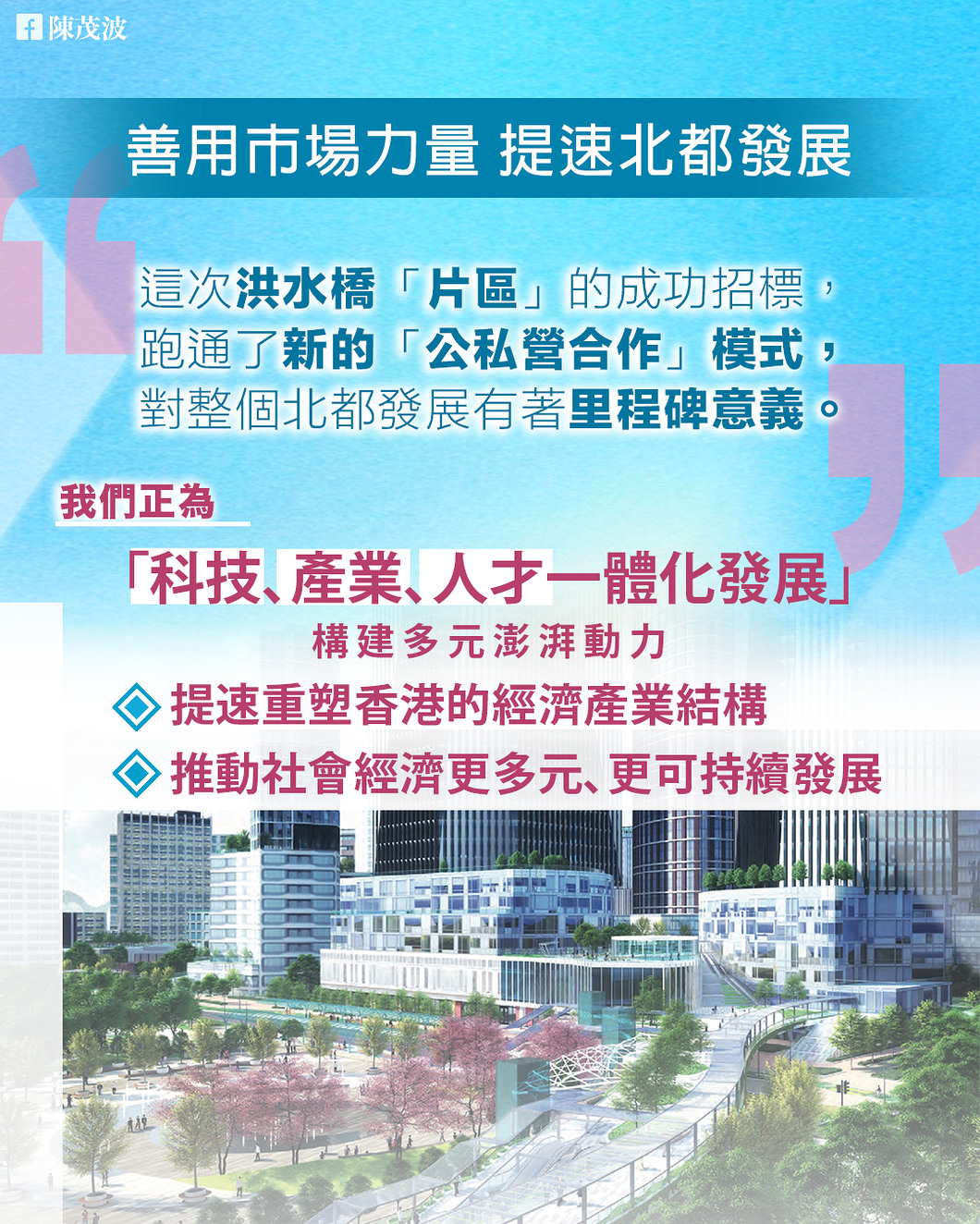
The Northern Metropolis is a key new engine for Hong Kong’s future economic growth. We recently announced the tender result for the first “large-scale land disposal” project in the Northern Metropolis — a new milestone in its development. For the 11-hectare pilot area in Hung Shui Kiu, we moved away from the traditional cash tender approach of awarding the land to the highest bidder. Instead, we adopted a “two-envelope approach”, which places greater weight on how much a tender proposal will contribute, over the long term, to Hong Kong’s industrial development and the wider economy.
The successful bidder is a company formed by a consortium of six enterprises from different sectors — local developers, Mainland state-owned enterprises and a leading e-commerce technology company — whose combined strengths cover infrastructure development, technological innovation, facility operation, supply chain management, business networks and ecosystem building. Price was not the only consideration in the tender assessment. Greater weight was given to whether the bidder could attract strategic industries, create jobs and drive the development of industry chains. This ensures that the successful bidder is not merely a property developer, but a long-term strategic partner with strong all-round capabilities and a proven track record of delivering concrete results in industrial development. The successful bidder will invest a total of about $16.8 billion in the project, which is expected to generate more than 6,000 jobs in construction, logistics operations, business management and other areas.
|
The innovative large-scale land disposal model enables the Government to mobilise private sector resources and capitalise on the market’s flexibility, responsiveness, professional knowledge and experience. It can accelerate project delivery and ensure that the development better serves the needs of its users at every stage, from design and construction through to future operation. The successful bidder will also be required to provide public facilities and open space, and to undertake site formation works for certain land parcels to be handed back to the Government. By reducing the Government’s upfront cash commitment, the model delivers a win-win outcome.
Hong Kong is in fact no stranger to public-private partnership models. Market forces have long played a part in taking forward land development and infrastructure projects — well-known examples include City One Shatin and the tunnels built under the build-operate-transfer (BOT) model. The successful tender for this large-scale land disposal project establishes a new public-private partnership model, and is a milestone for the development of the Northern Metropolis as a whole. We will keep in close touch with the market, monitor market conditions closely and launch tenders for the other pilot areas at an appropriate time.
The development blueprint for the Northern Metropolis is ambitious. Research by a major bank estimates that the Northern Metropolis will create 500,000 new jobs and account for at least 13% of Hong Kong’s GDP, with technology-related activities making up about four percentage points of that — a significant boost to technology’s contribution to the economy. Realising this blueprint calls for more than innovation in land policy. We must also tap the vast resources of the financial market to provide stable, long-term funding for development on this scale.
To this end, the Hong Kong Monetary Authority and the Hong Kong Association of Banks established the Northern Metropolis Financial Advisory Taskforce in April this year. Comprising 23 banks with experience in large-scale project financing, the Taskforce has held two meetings to date. The participating banks will explore financing solutions tailored to the characteristics of individual Northern Metropolis projects, including syndicated loans, bond underwriting, infrastructure financing, securitisation and other ancillary financial services. This matters for projects such as innovation and technology parks, industrial developments and modern logistics facilities, because each has its own construction period, cash flow, risk profile and return profile, and each calls for flexible financial instruments.
We are also actively tapping the bond market to fund infrastructure in the Northern Metropolis. In May this year, we successfully issued green bonds and infrastructure bonds totalling $27.6 billion under two bond programmes. Total subscriptions reached almost $240 billion, or some 8.6 times the issue size, with orders received from global investors across more than 30 markets.
Notably, against the current geopolitical backdrop, investor demand for Hong Kong dollar bond products has risen markedly. Market data show that Hong Kong dollar bond issuance – wonton bonds – from the start of this year to mid-August exceeded $670 billion, up nearly 80% year on year and already ahead of last year’s full-year total of about $620 billion. Several local public bodies have also launched large bond offerings, which were readily absorbed by the market. This is a vote of confidence by international investors in Hong Kong’s public finances, exchange rate stability and development prospects, and it gives us ample scope to continue drawing on market resources to speed up the development of the Northern Metropolis.
With funding and land in place, the ultimate test of the Northern Metropolis will be whether it can attract high value-added, high-potential industries and quality enterprises to establish their presence there, allowing an innovation and technology ecosystem to flourish. That means using capital as a lever and platforms as vehicles to steer market forces towards substantive industrial development.
In this regard, the Hong Kong Investment Corporation Limited (HKIC) serves as one of our principal vehicles for developing the industrial ecosystem. HKIC will continue to align its work closely with the National 15th Five-Year Plan, extending its investments into future industries such as embodied artificial intelligence (AI), commercial aerospace and brain-computer interfaces. Tomorrow, an embodied AI company in HKIC’s portfolio will hold a ceremony to launch its fully autonomous robot retail store in Hong Kong. The company is committed to using Hong Kong as a base to deepen scenario-based applications, expand its international business, attract top talent and carry out related research and development.
At the same time, the Hong Kong Science and Technology Parks Corporation (HKSTP), one of Hong Kong’s flagship innovation and technology (I&T) institutions, is actively building platforms to speed up investment matching in I&T. Next week, it will host the Co-Development and Investment Conference, which will bring together more than 200 start-ups and over 200 investors, along with a number of major technology companies, to develop more of the solutions that different industries need. The conference will subsequently be held in Dongguan in the Greater Bay Area and in Hangzhou in the Yangtze River Delta, connecting I&T resources across regions to maximise synergy.
Whether by unlocking land value through large-scale land disposal, by providing long-term capital through the financial market, or by guiding industries to take root through HKIC and HKSTP, we are building real momentum behind the integrated development of technology, industry and talent. The Government sets the vision, draws up the long-term plans and clears the way; the market invests, brings in the industries and runs the businesses. This chain linking land, capital and industry will reshape Hong Kong’s economic and industrial structure more quickly, enabling us to integrate better into and serve the overall development of the country under the National 15th Five-Year Plan and Hong Kong’s Five-Year Plan. That, in turn, will make our socio-economic development more diversified, resilient and sustainable. For the public, it means a wider range of quality jobs and a better living environment.
August 30, 2026