Blog
A New Milestone for Offshore Renminbi Business
With the strong support of relevant central ministries and authorities, the long-awaited offshore RMB China Government Bond Futures will be listed in Hong Kong tomorrow. The debut contract to be listed will be a five-year product, currently the only product of its kind in the offshore market. It will allow international investors to trade and settle the relevant contracts in the offshore market using their existing trading accounts, practices and procedures in Hong Kong.
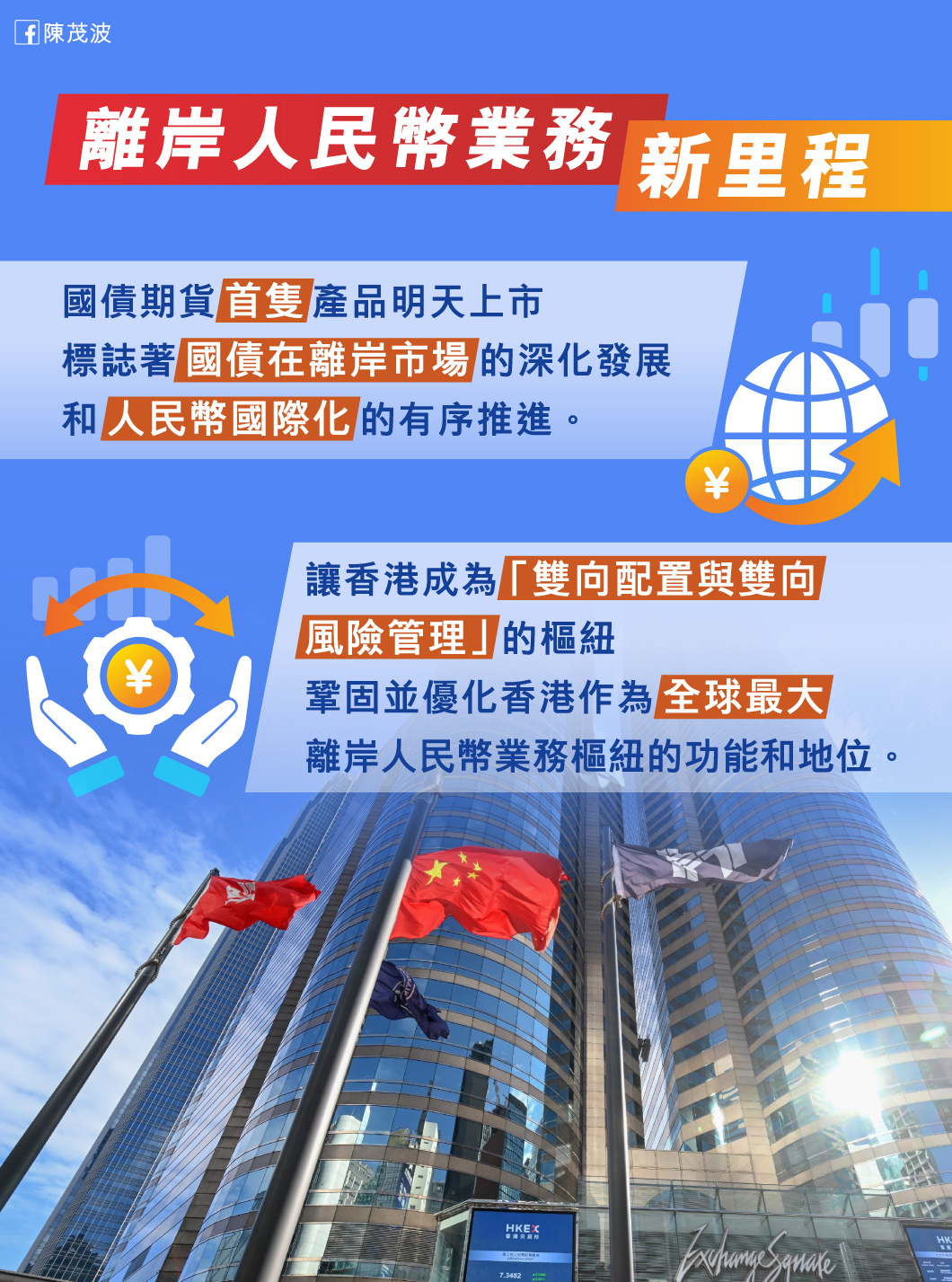
This marks a new milestone in Hong Kong's development as an offshore RMB business hub. It not only enriches the range of RMB risk management tools available in our market, but also signifies the deepening development of China Government Bonds in the offshore market and the orderly advancement of RMB internationalisation.
Bond Connect was launched in 2017, facilitating overseas investors to participate in the Mainland bond market through Northbound Bond Connect. Southbound Bond Connect was subsequently launched, enabling two-way trading. Three years ago, Swap Connect was introduced, allowing investors to hedge interest rate risks for their onshore bond holdings. The launch of China Government Bond Futures this time provides a standardised, exchange-traded and liquid offshore hedging tool for Chinese Government Bonds. In other words, Bond Connect, Swap Connect and now the launch of China Government Bond Futures have completed the loop for risk management between the cash bond and futures markets. This allows overseas investors to participate in RMB Chinese Government Bond trading in the offshore market more efficiently and conveniently, with the Hong Kong market playing a key role.
|
This development is underpinned by the continued expansion of investors' demand for northbound asset allocation. Bond Connect has long been the main channel for overseas investors to access the Mainland's onshore bond market, accounting for about two-thirds of overall trading. The Chinese bonds held through this channel exceeded RMB 3 trillion as at the end of June this year, representing nearly a threefold increase from about RMB 800 billion at the end of 2017. The expansion in holdings reflects not only stronger investment appetite, but also leads to greater demand for risk management.
In fact, the development of Hong Kong's offshore RMB market has continued to deepen. Issuance of dim sum bonds exceeded RMB 1 trillion in each of the past two years, with outstanding volume surpassing RMB 1.6 trillion. The monthly settlement amount through the interbank settlement system is approaching RMB48 trillion. At the same time, we are accelerating the development of an international gold trading centre and a commodities trading ecosystem, supporting the launch of more RMB-denominated products.
The development of the offshore RMB market is built on the country's growing economic strength, as well as its sound economic and monetary policies. In the first half of this year, China's total imports and exports of goods exceeded RMB 25 trillion, representing year-on-year growth of 16.9% and reaching a record high. Globally leading industrial clusters are also taking shape at an accelerating pace in areas such as new energy, electric vehicles, artificial intelligence, embodied intelligence and storage chips. The continued deepening of international economic, trade and industrial cooperation will inevitably create more use cases for the RMB — from trade settlement to investment, and from asset allocation to central bank reserves. The further development of RMB internationalisation requires the support of a comprehensive and highly efficient offshore market.
From northbound bond allocation and interest rate hedging, to offshore financing and clearing, and on to RMB-denominated trade settlement, these functions are converging in Hong Kong. This makes Hong Kong a hub for two-way allocation and two-way risk management. We will continue to play our role as a bridge connecting the Mainland and global markets, and actively promote the sound, steady and deeper development of the offshore RMB market. In doing so, we will reinforce and enhance Hong Kong's function and status as the world's largest offshore RMB business hub.
Hong Kong's own economic and financial performance has also provided a favourable environment for this upgraded development. In July, the Hang Seng Index rose by about 3,000 points, or 13%. This was the largest monthly gain in nearly two years in terms of increase in points. Average daily turnover remained above HK$300 billion for the second consecutive month. A number of high-quality technology companies have continued to apply for listing in Hong Kong. In the first seven months of this year, total funds raised through Hong Kong IPOs had already exceeded the full-year total for last year by 13%. Post-listing fundraising by listed companies also increased by more than 20% year on year.
Apart from the financial markets, Hong Kong's overall economy has also continued to grow steadily. Supported by buoyant external trade and resilient domestic demand, the Hong Kong economy has recorded growth for 14 consecutive quarters. Real Gross Domestic Product grew by 4.3% year-on-year in the second quarter of this year. Within which, exports of goods remained particularly strong, with growth accelerating further to 28.8% in real terms in the second quarter. Private consumption expenditure also grew steadily by 2.9% in real terms.
Hong Kong's economy grew by 5.1% in the first half of this year, stronger than expected. In the second half of the year, merchandise exports should continue to benefit from strong global demand for AI products. Continued external demand for Hong Kong's financial and business services, together with an increase in visitor arrivals, would support growth in exports of services, and is conducive towards local consumption and investment sentiments. Taking into account the overall economic situation, the revised full-year economic growth forecast to be released in the middle of this month will be adjusted upwards from the original forecast range. Nonetheless, the outlook would still be affected by geopolitical developments, US interest rates and other uncertainties. We will remain highly vigilant, and step up efforts to accelerate economic development while safeguarding economic and financial security.
August 2, 2026