Blog
AI for Good and for the People
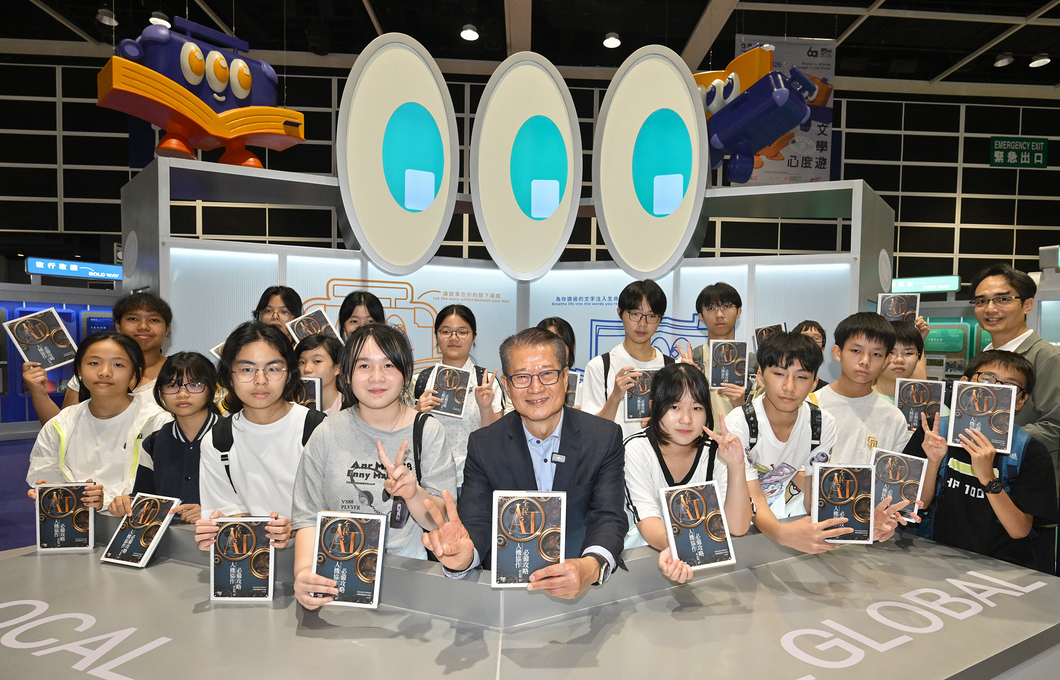
The Hong Kong Book Fair is currently underway at the Convention and Exhibition Centre in Wan Chai. In recent years, I have made a point of visiting the fair with young people and picking out a book as a gift for them. The year before last, it was One Hundred Thousand Whys. Last year, it was Physics in Graphics. This year, I chose a book on the applications of artificial intelligence (AI) and human-AI collaboration. Taken together, the books from these three years trace a clear trajectory: from exploring principles and understanding science to applying cutting-edge technologies. At this year’s Book Fair, innovation and technology (I&T) – AI in particular – feature far more prominently, whether in the books, the exhibitions or the seminars. The popularity of the AI theme shows that it is no longer merely an imagined future confined to the pages of books; it is becoming part of everyday life.
|
| Last week, I visited the Hong Kong Book Fair with a group of secondary school students. I chose a book on AI applications and human-AI collaboration for them as a gift. |
Indeed, technological innovation and AI have quickly become indispensable parts of our lives. At the Book Fair, the “World of Art & Culture” zone features an interactive installation that instantly generates a personalised reading list based on visitors’ personalities and reading preferences. Government booths also showcase how AI can improve public services – for instance, by enhancing landslide warning systems. It is fair to say that this generation of young people is growing up with AI. Whether for supporting learning or gathering information for their projects, AI has become a partner in their daily work and thinking process.
In the age of AI, rather than passively adapting to change, we should take the initiative to deepen our understanding of its underlying principles and put it to good use. AI may gradually take over highly repetitive and mechanical tasks, but in doing so it frees up time and space for us to focus on work that calls for analytical thinking and creativity. In other words, AI can serve as an amplifier of human intelligence and decision-making.
AI is being applied at many different levels, including a shift from chat-based interaction to embodied intelligence in the physical world. This shows that AI is moving out of the digital realm and into the real world, reaching into every aspect of daily life. Like computers and the Internet before it, AI will become a cornerstone of economic and social development. Today, everyone needs to know how to use a computer, even if not everyone needs to be an engineer. The far-reaching changes brought by AI will affect not just individual industries; they will transform the very ways we learn, live, work, do business, and create.
|
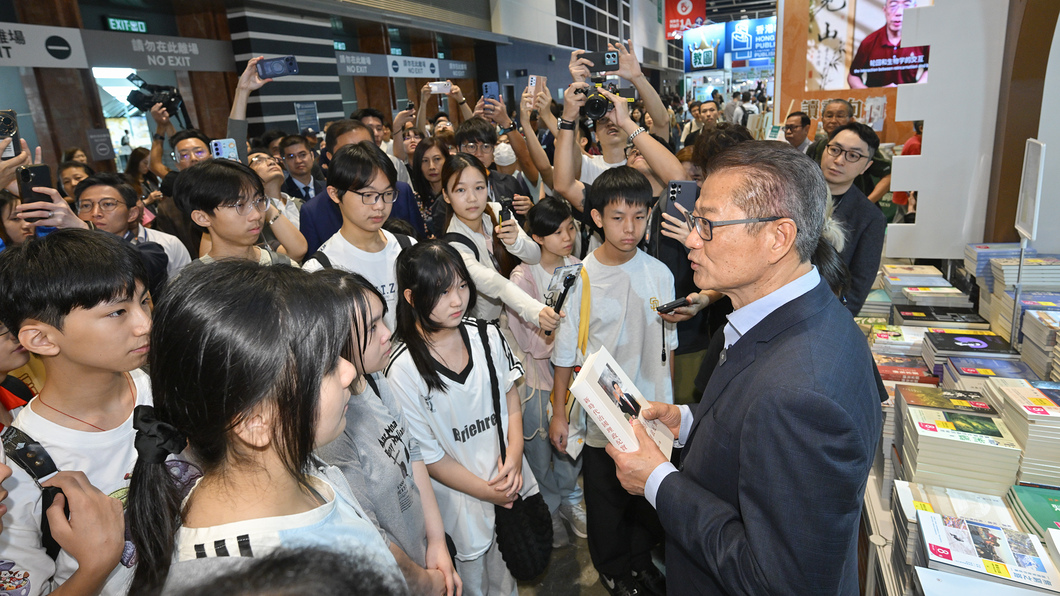
| At the Book Fair, I introduced President Xi Jinping’s works on state governance to the students. |
|
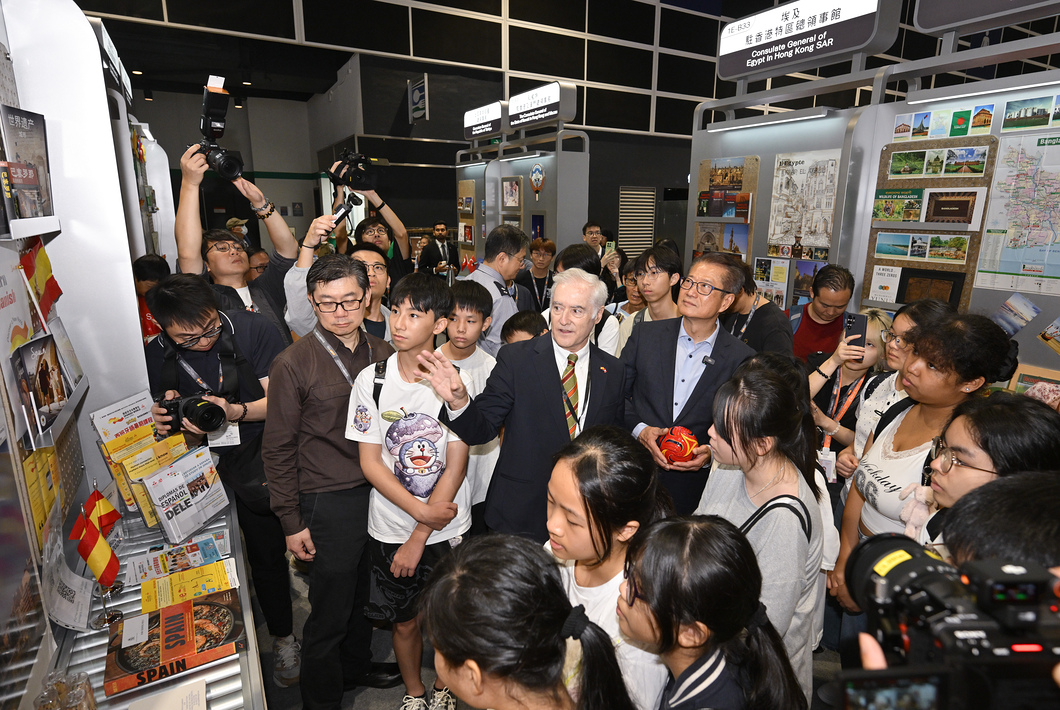
| The Consul General of Spain in Hong Kong, Mr Miguel Aguirre de Cárcer García del Arenal, briefed us on Spain’s exhibition zone at the Book Fair. |
Hong Kong has been an active participant in the broader wave of technological innovation and application, while at the same time moving full speed ahead to deepen support for local adoption. Last month, the Committee on AI+ and Industry Development Strategy held its first meeting, discussing key areas ranging from research and innovation, data flow and security, and computing power to application scenarios, talent development and funding. This marked a new stage in Hong Kong’s AI development – a shift from advancing individual initiatives to adopting a more systematic approach, with the aim of empowering industries across the board through AI. In its initial phase, the Committee will focus on life and health technology and embodied intelligence: the former is where Hong Kong holds considerable strengths in research, while the latter can draw on the industrial hinterland of the Greater Bay Area. Within this year, we will roll out an enhanced version of the Digital Transformation Support Pilot Programme to help small and medium-sized enterprises adopt ready-to-use AI solutions.
We attach great importance to building the infrastructure and ecosystem needed to support this vision. On the computing power front, construction of the Sandy Ridge Data Facility Cluster site is now underway; by 2032, it is expected to deliver around 180,000 PFLOPS – equivalent to 36 times Hong Kong’s current total computing capacity. The Hong Kong Artificial Intelligence Research and Development Institute is also set to commence operation soon. Meanwhile, 56% of the funds committed by the Hong Kong Investment Corporation Limited last year went to hard technology, including AI, while also fostering the ecosystem development of the RISC-V open-source architecture. Together, these efforts will strengthen our computing capacity and nurture a vibrant ecosystem for AI applications.
Ultimately, technological innovation and application come down to people. Our “AI Training for All” initiative will span three levels: basic outreach, professional empowerment and practical enhancement. It aims to help members of the public try AI, learn to use it, and apply it more effectively.
|
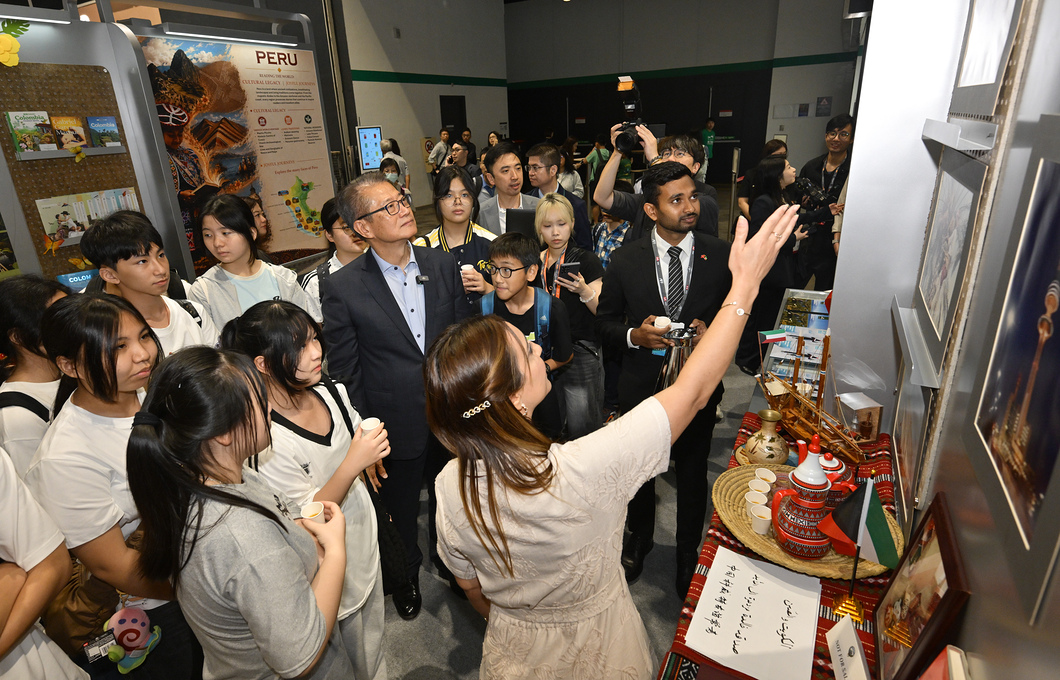
| A representative of the Consulate General of the State of Kuwait in Hong Kong briefed us on Kuwait’s exhibition zone at the Book Fair. |
|
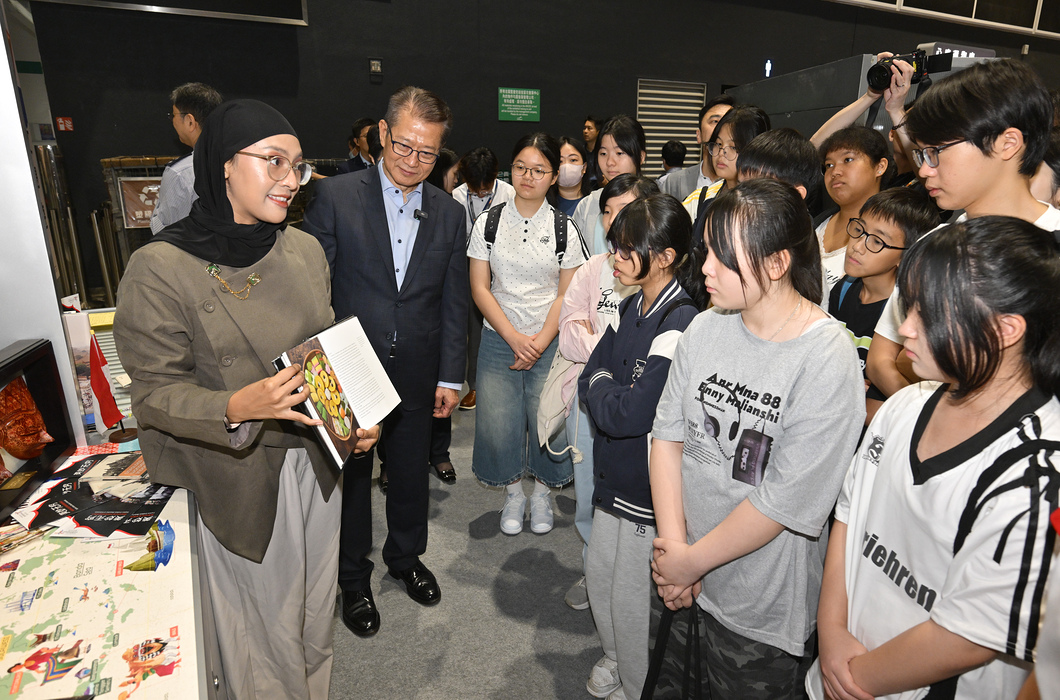
| A representative of the Consulate General of Indonesia in Hong Kong briefed us on Indonesia’s exhibition zone at the Book Fair. |
For the global economy, AI is a new engine of growth, but it also brings new risks and challenges. No economy can achieve every breakthrough on its own, nor can any economy address every risk alone. Development and governance must go hand in hand, and mutual benefit and inclusive growth must be valued, so that we can move not only quickly, but also steadily and sustainably. At the World Artificial Intelligence Conference held in Shanghai a few days ago, President Xi Jinping delivered a keynote address, noting that AI is an important driver for shared prosperity and common security. The World Artificial Intelligence Cooperation Organization, initiated by our country, has now been established, with 29 countries signing the agreement to become founding members. “Taking a people-centred approach and developing AI for the positive and for good” is emerging as a shared goal widely embraced in international technological development. We firmly believe that technological progress should make people’s lives better, and we must work to ensure that its benefits reach as many people as possible.
As an international I&T centre, Hong Kong is leveraging its distinctive advantage of being connected to both the Mainland and the world under the “one country, two systems” framework. We serve not only as a hub for AI research and development (R&D) and outcome transformation, but also as a strategic springboard for Mainland AI enterprises going global – helping them align their frontier technologies and business models with international standards and practices. Our role as a highly efficient international financial centre further provides robust funding support for these ventures and transformations. Together, these strengths are drawing a growing number of technology enterprises to Hong Kong. In recent months, we have engaged with many AI-related companies – suppliers spanning hardware and equipment, key materials and computing power – and they have expressed their intention to expand their operations here and use the city as a platform for wider global growth.
Future competition in AI will not be merely about scaling up models in size and speed; it will be a comprehensive contest spanning application scenarios, data environments and talent. This new wave of competition will also test our ability to make technology more inclusive and to ensure that it truly benefits humanity. In Hong Kong, we are committed to developing the city into a hub for R&D in AI and outcome transformation, a launchpad for AI applications going global, a magnet for AI talent, and a source of end-to-end funding support. We look forward to working with all sectors to make AI a new driver of high-quality development and a solid foundation for digital livelihoods – as well as a bridge, a pathway and a stage on which young people can pursue their dreams and the society can move forward.
July 19, 2026