Blog
Building Consensus for a New Chapter of Hong Kong
As the country embarks on the 15th Five-Year Plan, we stand at a pivotal moment in the new era of artificial intelligence (AI). How Hong Kong seizes this opportunity, plays to its strengths, serves the nation's needs and harnesses that momentum for its own development, will be decisive for its future. With that in mind, we will launch the public consultation tomorrow for Hong Kong's First Five-Year Plan.
Some may ask: in an era of rapid change, is a five-year plan too long a horizon? Five years ago, no one could have foreseen that AI would reshape industries at such speed. Five years from now, we likewise cannot predict what the next disruptive technology or pivotal shift will be. Yet macro trends tend to follow clear and stable patterns. As our country progresses steadily, and digital and intelligent technological advancement gathers pace across the board, the direction ahead has been set amid an uncertain future. A five-year plan will give the business community, enterprises and members of the public a clearer framework to plan for the future. It will also help the society build consensus, pool resources and channel collective energy into shared development.
|
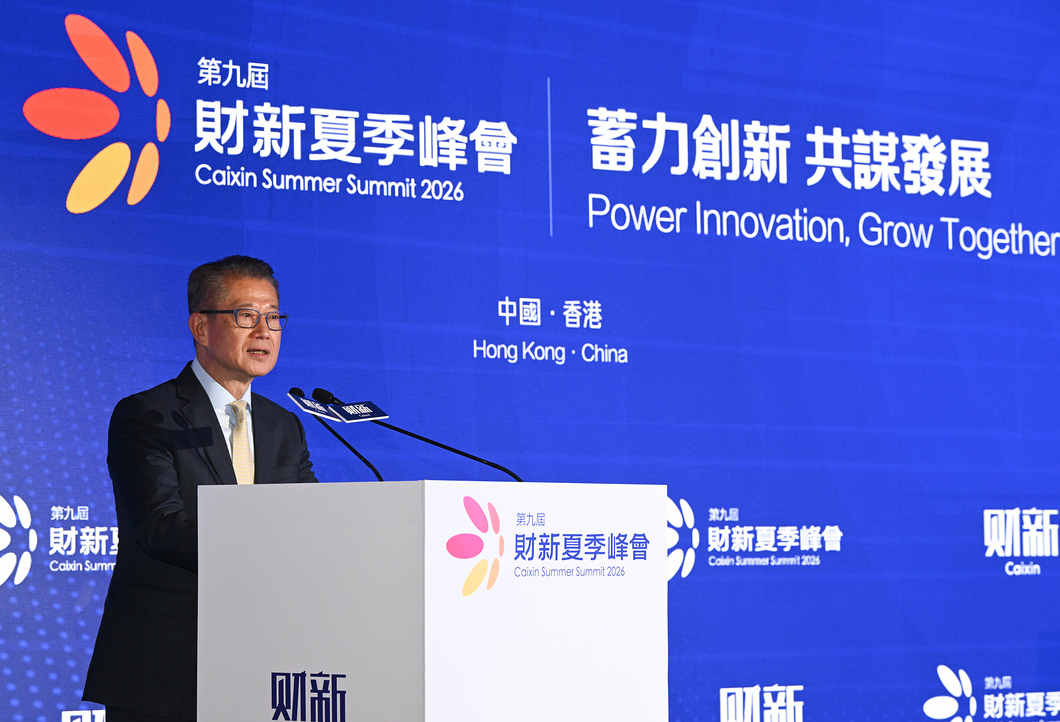
| Speaking at the Caixin Summer Summit 2026 last week. |
We look forward to sparking richer insights and broader perspectives through continued exchanges and discussions. By staying responsive to changing times and local circumstances, we can fully unlock Hong Kong's potential and, working together in common purpose, achieve something great.
The National 15th Five-Year Plan sets out a clear and forward-looking vision for Hong Kong: to reinforce and enhance its status as an international financial, shipping and trading centre; develop into an international innovation and technology (I&T) centre; strengthen its role as a global offshore Renminbi business hub; build an ecosystem for commodities trading; and grow into an international hub for high-calibre talent, among others. These priorities have given Hong Kong clear strategic directions. But how do we translate these directions into concrete advantages—playing to Hong Kong's distinctive strengths while addressing its gaps? How do we map out practical pathways and maximise the returns on development? These are precisely the issues the consultation needs to address. Drawing a clear line of connection—from national positioning through industrial opportunity and sectoral pathways to development of individuals—requires not only a thorough review of where we have been, but a broad and ambitious vision of where we are headed.
Hong Kong’s development has consistently benefited from the country’s long-term planning and sustained progress, while we also contribute distinctively to national development in return. In finance, leading enterprises from the country's I&T sector have continued to raise the "technology quotient" of Hong Kong stocks. New economy companies now account for around 25% of the total market capitalisation of the Hong Kong stock market. Stock market liquidity has also continued to grow, with average daily turnover exceeding HK$270 billion in the first five months of this year, up 14% year on year. In trade, as the country's industrial base expands—supported by the broadening regional footprint of industrial and supply chains and manufacturers' push into new markets such as Southeast Asia and the Middle East—Hong Kong's goods exports have shown tremendous resilience in a challenging and volatile global environment. They grew by more than 15% for the whole of last year and rose a further 35% in the first four months of this year. The five-year plan consultation is not merely about sustaining these positive trends, but about consolidating and enhancing them, opening up new growth frontiers, and generating new engines of development.
Industrial development, as well as economic upgrading and transformation, will be our key priorities. We must accelerate the development of the Northern Metropolis as a strategic platform for building emerging and future industries. Over the past few years, we have made encouraging progress in attracting business and investment, as well as drawing frontier technology enterprises to Hong Kong. Across the different dimensions of "AI+", we have also laid a solid foundation—building computing power infrastructure, supporting frontier research, encouraging industrial applications, attracting high-calibre talent, and developing a comprehensive financing ecosystem. The next questions facing us are: how can these technologies and capital take deeper root in Hong Kong, scale up and create more high-quality employment? How can industrial space planning better respond to the needs of enterprises at different stages, from early-stage R&D and start-ups through to maturity and expansion? How can we further strengthen the AI literacy of members of the public, so that they can better understand, embrace and make effective use of AI? To address these questions, we must listen carefully to the industry, investors, research institutions, academia and every stakeholder.
|
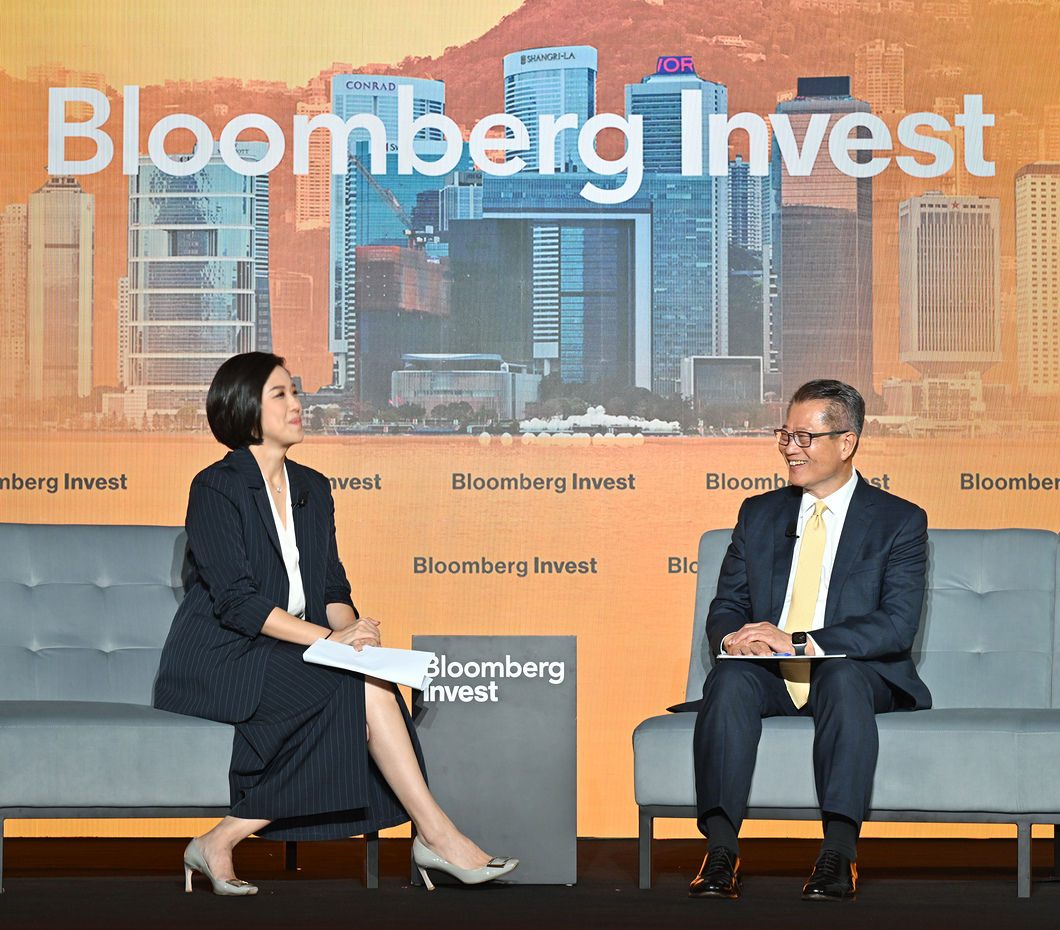
| Taking part in a fireside chat at the Bloomberg Invest Hong Kong Summit last week. |
“AI+” and “Finance+” are two strategic directions worthy of deeper exploration. AI is no longer simply an I&T sector in its own right; it plays a crucial role in raising the competitiveness of various industries. In trade, it can be integrated with business data to improve the efficiency of trade finance. In finance, it can strengthen data analytics, risk management and customer service. "Finance+", meanwhile, means making full use of Hong Kong's end-to-end fundraising and financing capabilities—including building a more comprehensive patient-capital ecosystem to fuel the growth of frontier technology enterprises. We look forward to hearing public views during the consultation on how these efforts can be further strengthened and deepened.
We must also strengthen coordinated development with regions across the country. On a global level, the Guangdong-Hong Kong-Macao Greater Bay Area (GBA) is the only city cluster that combines strengths in AI, advanced manufacturing, international application environments, and is home to an international financial centre. We need to further promote alignment of rules and mechanisms, as well as the more efficient flow of various factors of production within the GBA. Besides, the Yangtze River Delta and the Beijing-Tianjin-Hebei region are likewise important engines of regional development for the country. The 15th Five-Year Plan calls for stronger efforts to promote coordinated regional development. This week, I will travel to Shanghai and Nanjing. In Shanghai, I will attend the Lujiazui Forum to discuss further financial cooperation between Shanghai and Hong Kong, and to advance more concrete, mutually beneficial collaboration. In Nanjing, I will visit I&T enterprises to strengthen exchanges in science and technology, and to explore how finance can better support and empower that development.
Hong Kong’s Five-Year Plan is not only about generating stronger economic momentum and enabling the wider application of technology; it is also about building a more inclusive society, creating more high-quality employment opportunities for our people, and enabling a better life for all. The public consultation will last for two months, during which public views will be gathered through various channels. Let us join hands and move forward together, so that Hong Kong can advance on a stronger foundation.
June 14, 2026