Blog
Artificial Intelligence for Good
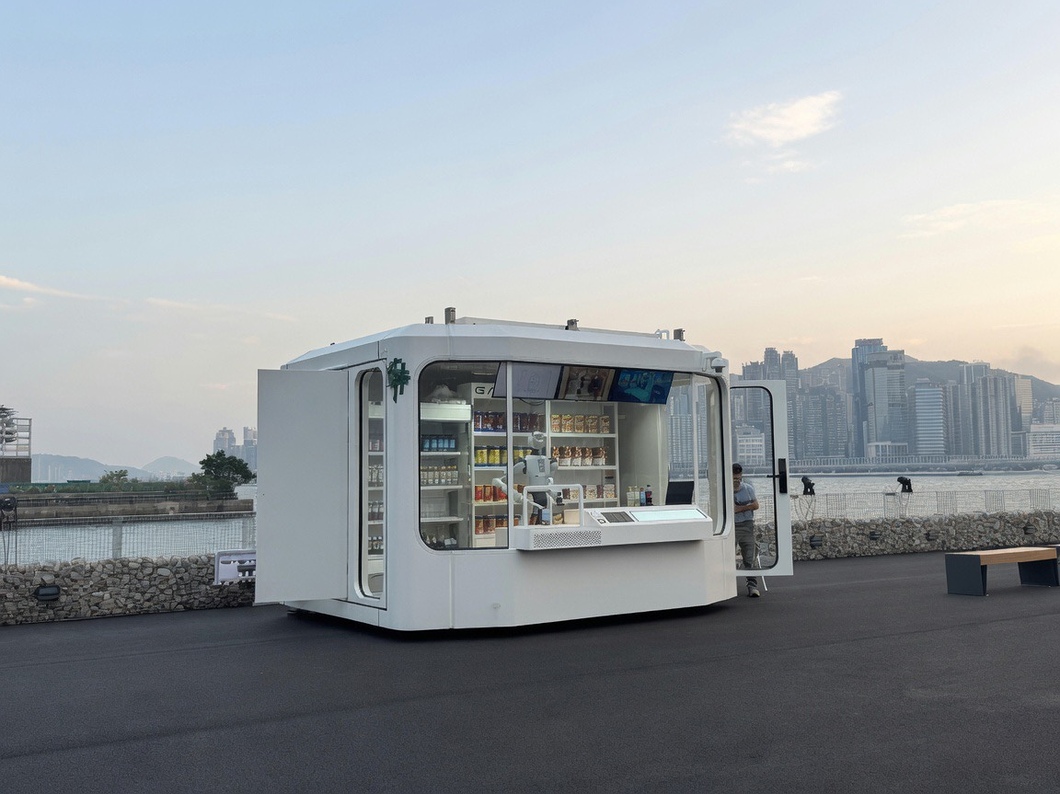
Our country is a global leader in embodied intelligence, with application scenarios expanding rapidly beyond factory floors and performance venues into everyday life. An embodied-intelligence company from the Chinese Mainland, introduced by the Hong Kong Investment Corporation Limited, will soon open its first fully autonomous robotic retail store outside the Mainland on the Hung Hom waterfront. The store will feature a humanoid robot manager providing multilingual customer service around the clock. The company’s management has chosen Hong Kong as the first stop in the global expansion of its retail store concept, specifically to leverage the city’s role as an international showroom, its open environment for piloting new technologies, and the strong visibility it offers for innovation and technology projects. International capital continues to follow closely, and remains optimistic about, our country’s leading position in various emerging and future industries. As an important international financing and fundraising centre for these enterprises, Hong Kong is becoming increasingly attractive to start-ups and technology companies.
The imminent debut of a humanoid robot store manager in Hong Kong points to an accelerating trend: artificial intelligence (AI) is entering people’s everyday lives in more tangible ways. In vigorously promoting AI development, we aim not only to empower industries and strengthen economic competitiveness, but also to deliver convenience that residents can truly experience, while creating new areas of growth and opportunity.
|
Over the past few years, we have advanced AI development at full speed across key areas including computing power, basic research, talent and application scenarios. Hong Kong’s overall computing power currently stands at 5,000 PFLOPS, while the Sandy Ridge Data Facility Cluster has entered the construction stage and is expected to deliver 180,000 PFLOPS by 2032 — equivalent to 36 times the city’s current computing capacity. To date, the Artificial Intelligence Subsidy Scheme has approved more than 30 projects, covering areas such as large language models, medical large language models and embodied intelligence. The Hong Kong AI Research and Development Institute will officially commence operations in the second half of this year. Meanwhile, The Hong Kong Science Park and Cyberport are now home to nearly 1,000 AI companies. Through collaboration among the Government, industry, academia, as well as the research and investment sectors, we are attracting more top-tier international AI talent to use Hong Kong as a base for research and development, exchange and entrepreneurship.
The above measures form part of our supply-side planning. As AI capabilities are rolled out more broadly, technologies evolve at pace, and the market develops rapidly, demand-side momentum is equally important: how AI is used, who uses it, whether it is well understood and how effectively it is applied. In technology adoption, scenarios often shape the market, while applications determine value. Progress on these fronts will determine how quickly Hong Kong can advance in AI development.
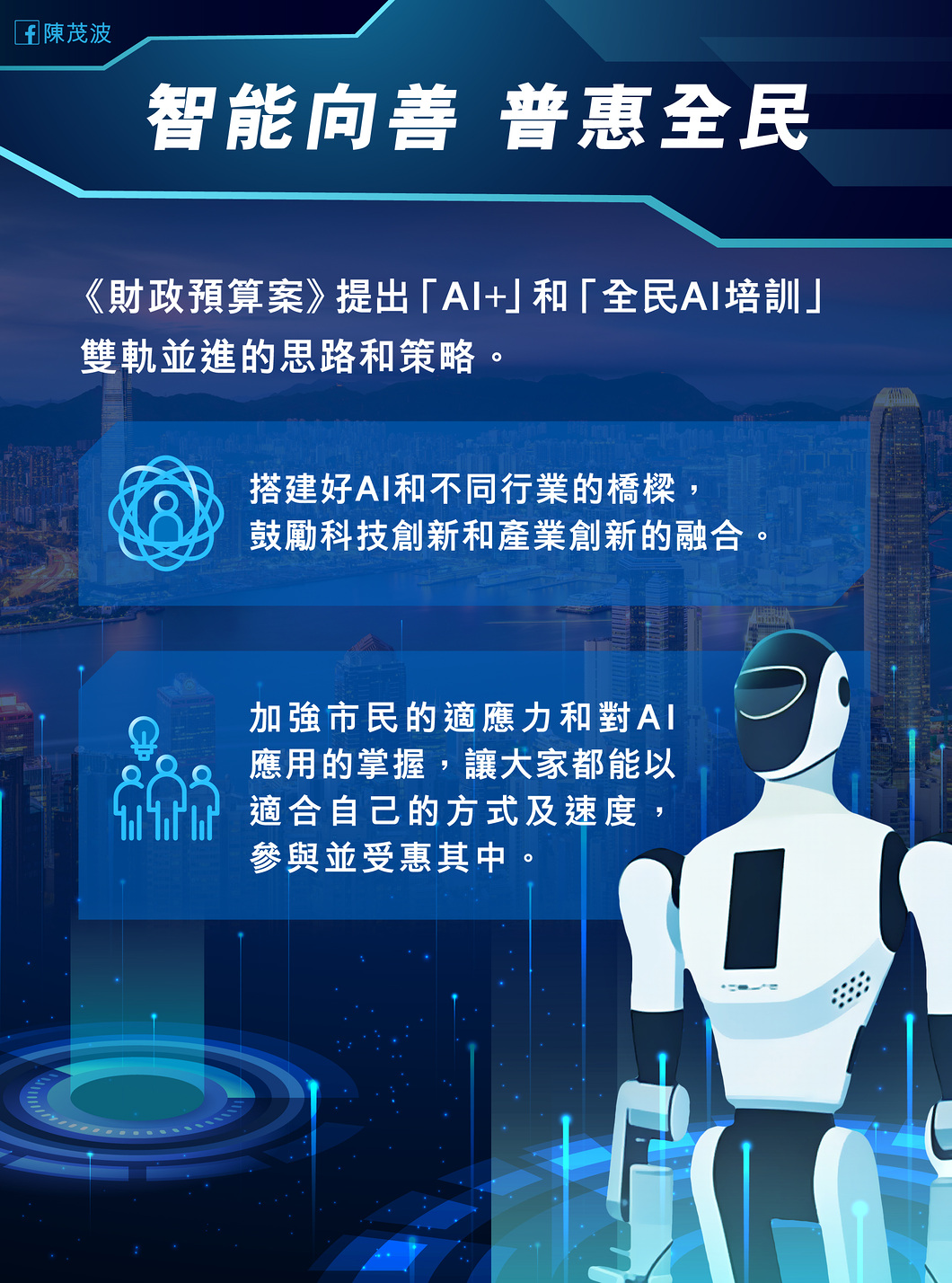
The dual-track approach of “AI + Industry” and “AI Training for All”, as proposed in the Budget, is designed precisely to build bridges between AI and different sectors. It encourages the integration of technological and industrial innovation, promotes product innovation and value creation, and strengthens training to enhance residents’ adaptability to, and mastery of, AI applications. This will enable people from all walks of life to participate in and benefit from AI in ways, and at a pace, that suit their needs, while building broader social consensus and support.
|
| A Mainland embodied intelligence enterprise introduced to Hong Kong by the Hong Kong Investment Corporation Limited will soon open its first fully autonomous robotic retail store outside the Mainland on the Hung Hom waterfront. |
The Committee on AI+ and Industry Development Strategy, announced in the Budget, has been successfully established. Its members include experts, academics, and representatives from chambers of commerce, enterprises, park companies and other sectors. The Committee will hold its first meeting later this month. Given the broad scope of AI empowerment, the Committee will initially focus not only on life and health technology, and embodied intelligence, but will also examine strategies for applying AI across a range of sectors, including transport, the cultural and creative industries, as well as sustainable development.
To implement “AI Training for All”, we have allocated $50 million and invited three organisations — Cyberport, the Hong Kong Science and Technology Parks Corporation, and the Hong Kong Productivity Council — to work with technology companies, tertiary institutions, industry chambers and others to organise AI application classes, seminars, competitions and other activities. The programme is expected to deliver more than 200 activities in the current and next financial years, benefiting around 50,000 participants in total. In addition, various education and publicity initiatives targeting a wider set of community groups will also be launched.
“AI Training for All” will necessarily take diverse forms to meet the needs of different groups. For students, for example, training can place greater emphasis on hands-on practice. Popular formats in recent years, such as hackathons and techathons, provide students with opportunities to test their ideas and learn through real-world market applications. Meanwhile, to help elderly people develop a basic understanding of AI tools, use them more effectively, and avoid being deceived, we will first provide training to community members and students, enabling them to become AI learning ambassadors for the elderly. This will not only promote intergenerational inclusion, but also help build a closer and more caring community.
Take vocational training as another example. The Higher Diploma programmes of the Vocational Training Council have already made AI a compulsory module, with AI application elements tailored to different industries. For the transformation and upskilling of working individuals, the Budget announced that the Employees Retraining Board would be upgraded into “Upskill Hong Kong”, providing various types of skills-based training, including in AI applications. Together, these three levels — the popularisation of AI across society, vocational pathways for young people, and transformation and upskilling opportunities for working individuals — will enable residents of different ages and circumstances to find a pathway suited to their needs.
We also attach importance to the needs of small and medium-sized enterprises (SMEs) in their technological and operational upgrading. This year, $300 million will be allocated to promote the enhanced Digital Transformation Support Pilot Programme, with a focus on supporting SMEs in adopting off-the-shelf AI and cybersecurity digital solutions. These solutions will help SMEs better anticipate consumer trends, optimise their marketing strategies, and automate more of their day-to-day operations.
Hong Kong has always grown through transformation and advanced through innovation. The AI era will test the society’s readiness for technological innovation across multiple dimensions, including digital infrastructure, regulatory regimes, technology application, the innovation ecosystem and talent development. We must take a forward-looking approach and make thorough preparations to seize the opportunities that lie ahead.
June 7, 2026