Blog
Industrial Synergy and Regulatory Alignment
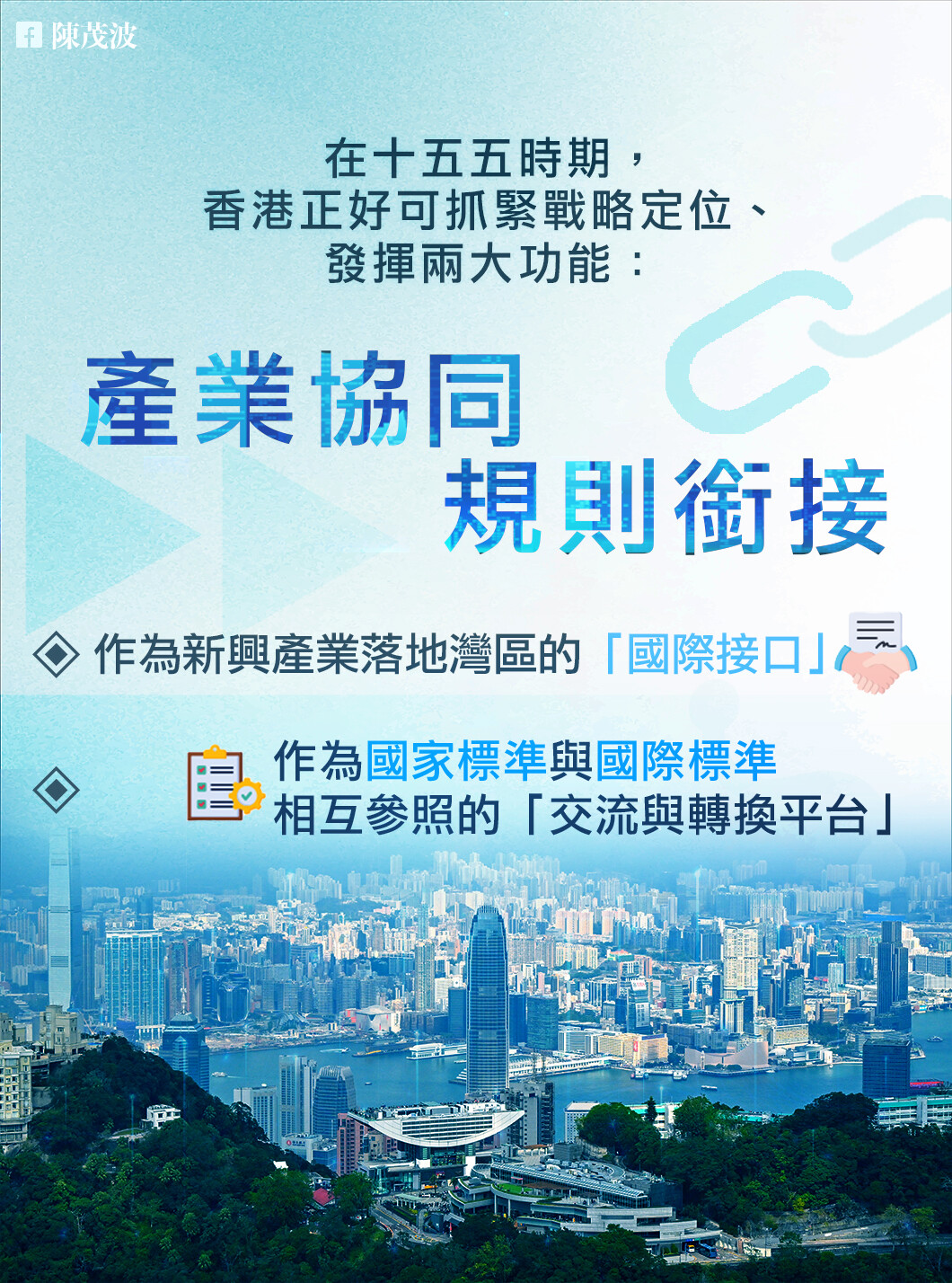
Across the world’s major bay-area economic clusters, the Guangdong-Hong Kong-Macao Greater Bay Area (GBA) is unique in combining three distinctive strengths: cutting-edge artificial intelligence (AI) research and development, a comprehensive high-end manufacturing ecosystem, and an international financial centre. This powerful combination of “AI + manufacturing + finance” places Hong Kong in an ideal position during the 15th Five-Year Plan period to assume a strategic role and perform two key functions: industrial synergy and regulatory alignment. In particular, Hong Kong can serve as an international gateway for emerging industries seeking to establish a presence in the GBA, as well as a platform for exchange and conversion through which domestic and international standards can be aligned and mutually referenced.
Last week, with the joint support of the Hong Kong SAR Government and the Dongguan Municipal Government, sustainable aviation fuel company EcoCeres signed an Investment Letter of Intent to establish its first supply chain operation in Dongguan. The company is a homegrown startup. The initiative exemplifies the synergy between Hong Kong’s strengths in upstream R&D and international green finance certification, and the GBA’s large-scale advanced manufacturing capabilities. It vividly illustrates the integration of technological and industrial innovation, demonstrating how the region’s cutting-edge green technologies can expand onto the global stage. It also highlights Hong Kong’s role as an international gateway for innovation and technology development in the GBA. Notably, EcoCeres is one of the projects backed by Hong Kong Investment Corporation Limited, underscoring the strong support of the Government’s patient capital flagship for the green technology sector and its commitment to nurturing emerging industries.
|
To translate innovation into tangible outcomes and support their sustained growth, adequate space and infrastructure are essential. We are pressing ahead at full speed with the development of the Northern Metropolis, particularly the Hong Kong Park of the Hetao Shenzhen-Hong Kong Science and Technology Innovation Co-operation Zone and the San Tin Technopole, to promote the commercialisation and industrialisation of R&D outcomes. This year’s Budget has already earmarked resources to expedite the development of the key sites, with a focus on emerging industries such as AI and biomedicine. Together, these initiatives will enable our upstream R&D capabilities to forge deeper complementarities and closer collaboration with the GBA’s industrial strengths.
Industrial innovation cannot flourish without strong financial support. This year’s Budget introduced the “Finance+” strategy with a view to enabling the financial sector to better serve the real economy and support the development of a modernised industrial system. The strategy aims to provide technology enterprises with a full-cycle financing support, covering the startup, growth, listing and post-listing stages. Better leveraging this advantage will help accelerate the GBA’s all-round development. Later this month, the Shenzhen-Hong Kong Financial Cooperation Committee, jointly established by Hong Kong and Shenzhen, will convene to discuss key issues including financial market connectivity in the GBA during the 15th Five-Year Plan period, as well as deeper collaboration in fintech and green finance. These efforts will further strengthen the scale, depth and overall competitiveness of the GBA’s financial markets.
The deepening of industrial development and the flow of capital both require greater alignment of rules and standards to ensure smooth and efficient progress. With its common law system under the “one country, two systems” principle, internationally aligned regulatory framework, and mature professional services sector, Hong Kong plays an indispensable and pivotal role in advancing the alignment of rules and mechanisms within the GBA. This not only facilitates the cross-boundary flow of innovation-related elements and enhances the efficiency of resource allocation, but also provides critical support for promoting the internationalisation of the country’s advanced standards.
The construction sector provides a compelling example. The recently opened eastern section of the Fanling Bypass features a pedestrian footbridge that is the world’s first to be built using S960 high-strength steel produced in our country. With a strength three times that of ordinary steel, the material significantly reduces both material consumption and structural weight, lowering the footbridge’s construction cost by around 30% while also enabling more flexible and innovative design. This achievement reflects coordinated efforts on multiple fronts. Hong Kong’s academic sector conducted a systematic comparison of steel parameters used in the Chinese Mainland, Europe and the United States, and established a database of “equivalent steel grades” to help align high-end Mainland products with international standards. At the same time, the practical engineering work of Government departments has enabled high-end construction materials and technologies from our country to be applied in local infrastructure projects. This case marks the first validation of our country’s high-end manufacturing standards within Hong Kong’s engineering regulatory system, which is aligned with international practice, and provides an important reference point for interoperability between Chinese and international standards.
In the medical sector, standards alignment has also seen encouraging progress. Experts from Hong Kong and the Mainland have jointly developed hospital accreditation standards that integrate both international and national benchmarks, and these have already been adopted in some public hospitals. In addition, Hong Kong has established facilities such as chest pain centres and stroke centres in accordance with national accreditation standards. The Chest Pain Centre at Queen Mary Hospital is a notable example. After obtaining accreditation last year, its median door-to-balloon time fell significantly from 105 minutes to 53 minutes, helping to improve survival rates and treatment outcomes. These initiatives not only enhance Hong Kong’s overall healthcare standards, but also provide a valuable demonstration to the international community of the country’s healthcare standards, thereby supporting their international adoption.
Guangdong, Hong Kong and Macao are jointly advancing the development of the “GBA Standards” for voluntary adoption by industry, with the aim of enhancing the quality of products and services, promoting the integrated development of the GBA, and creating more favourable conditions for Mainland products and services to reach wider international markets. As of March this year, 270 standards had been promulgated, covering a broad range of areas, including electrical and mechanical engineering, transport, healthcare, education and more.
Looking ahead, in the 15th Five-Year Plan period, our country is vigorously fostering new quality productive forces, accelerating the development of strategic emerging industries such as AI, the low-altitude economy, and biomedicine, while making forward-looking plans for future industries including quantum technology, biomanufacturing, embodied AI and brain-computer interfaces. We are confident that, under the “one country, two systems” framework, Hong Kong will leverage its unique advantage of being backed by the Motherland and connected to the world, to deepen co-operation with its sister cities in the GBA, accelerate technological innovation and application, and make greater contributions to the mutual reference of national and international rules and standards.
May 10, 2026