Blog
Building Stronger Momentum with Innovation and Partnership
Hong Kong's role and standing as an international financial centre continue to strengthen and evolve. Despite the challenges posed by an increasingly complex geopolitical landscape, the city is cultivating new drivers of growth through sustained innovation and deeper collaboration. Last week, alongside welcoming the city's largest IPO so far this year, Hong Kong also saw the listing of its largest gold exchange-traded fund (ETF). Meanwhile, the Hong Kong Exchanges and Clearing Limited (HKEX), following the launch of a co-branded index with Bursa Malaysia, also announced plans to introduce related ETFs.
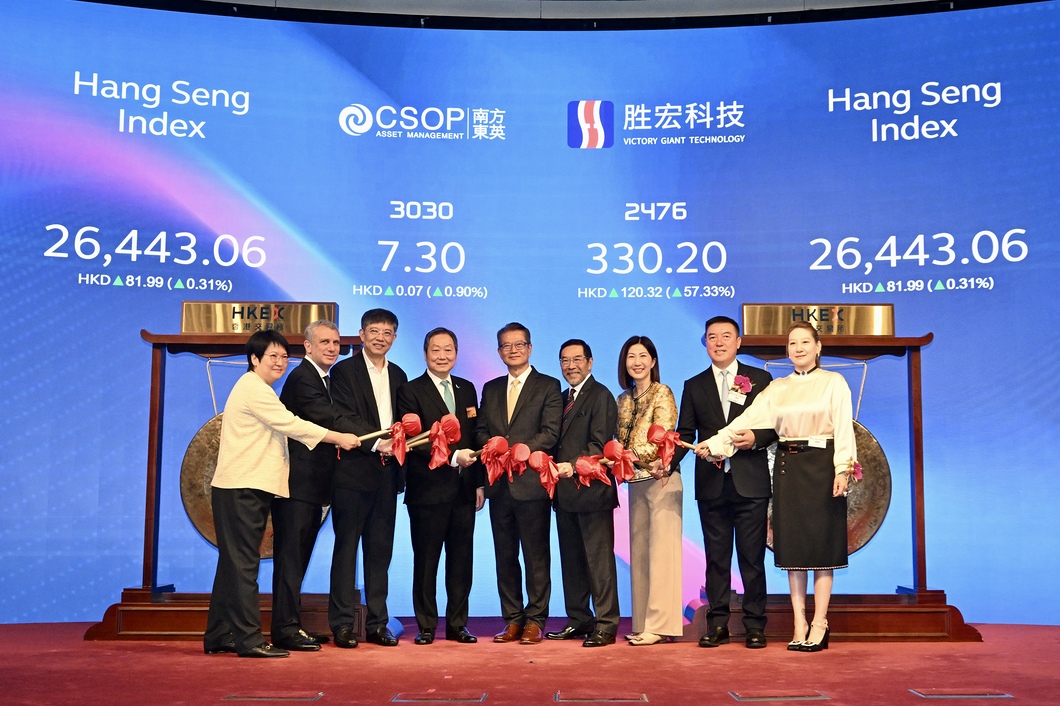
Building on its strong performance last year, Hong Kong has remained the world's leading IPO market so far this year. As of last week, funds raised through IPOs in Hong Kong had exceeded HK$140 billion. More high-quality companies are seizing the opportunity to leverage the city's vibrant fundraising platform to accelerate their global expansion. Since March, average daily turnover in the Hong Kong stock market has surpassed HK$280 billion. These developments show that, despite external uncertainties, Hong Kong's financial market continues to demonstrate strong momentum. This is the result of the concerted efforts of both the Government and the industry.
|
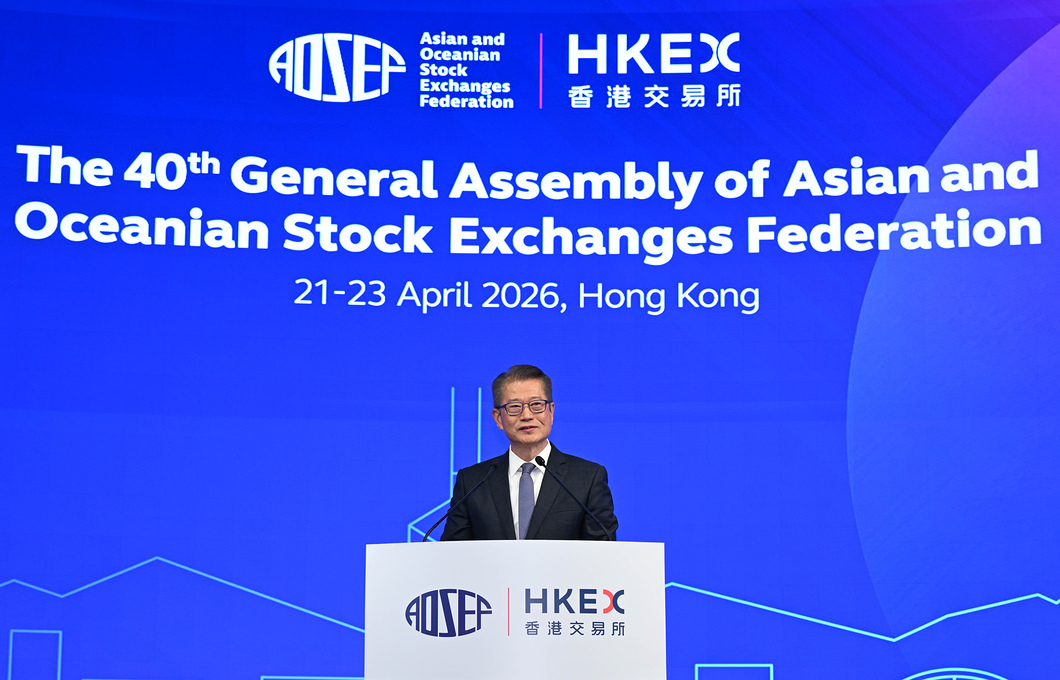
| Speaking at the 40th General Assembly of Asian and Oceanian Stock Exchanges Federation. |
|
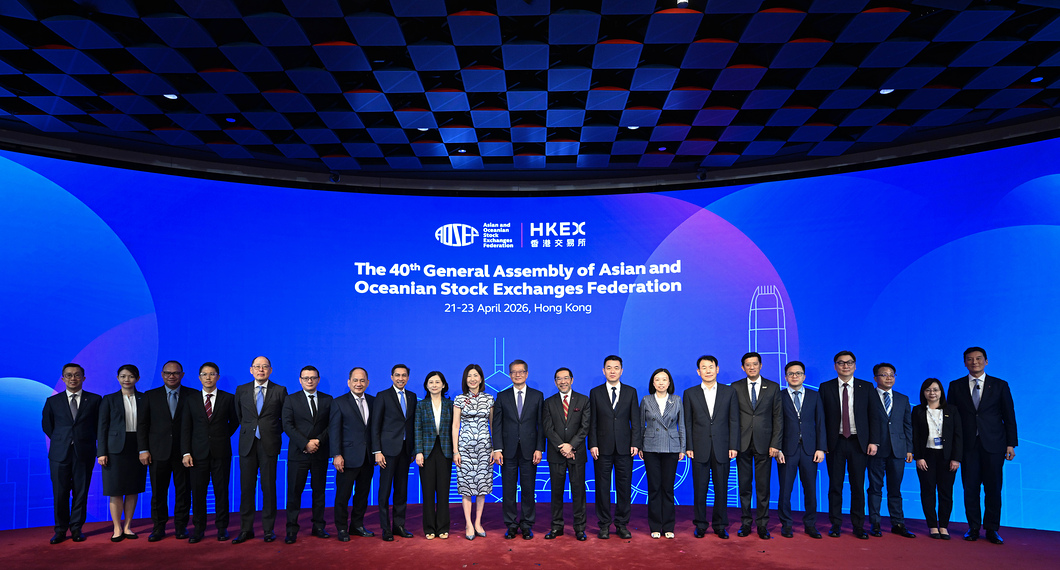
| Attending the 40th General Assembly of Asian and Oceanian Stock Exchanges Federation and taking a group photo with other local and international guests. |
At a time of rapid technological change and heightened geopolitical risk, global investors are accelerating the diversification of their asset allocation, reducing reliance on any single market or asset class. Meanwhile, Hong Kong is actively developing an international gold trading market, further deepening its financial ecosystem in response to evolving market demand. The listing of the city's largest gold ETF last week, which supports physical gold subscriptions and redemptions as well as trading and custody in Hong Kong, marks an important step in helping the city gradually build a comprehensive gold industry and value chain. Hong Kong's distinctive strengths — including its stability and security, its concentration of capital and talent, the free flow of key factors such as capital and data, and a legal system and rule of law that are well understood and trusted by the global business and financial community — are making it increasingly attractive to international investors.
As investment themes continue to evolve, the range of underlying assets for ETFs is steadily expanding, encompassing products linked to the spot and futures markets for precious metals, technology and semiconductor companies, and even digital assets. These thematic ETFs, including products with varying leverage features, provide investors with efficient and transparent investment options.
The features of ETF products also make them particularly well suited to cross-boundary collaboration. In recent years, we have advanced the mutual listing of ETFs with the Saudi Exchange. We also introduced a joint index with the Korea Exchange and promoted the listing of related ETF products. HKEX has also partnered with Bursa Malaysia to launch a co-branded benchmark index tracking the 60 largest listed companies by market capitalisation across the two markets. It has also authorised asset managers to issue related ETFs. This marks another important step forward in expanding cooperation in cross-market investment products.
In fact, the diversified development of the broader exchange-traded product (ETP) segment, which includes ETFs, underscores growing investor recognition of the themes, structures and trading efficiency of such products. By trading volume, Hong Kong's ETP market now ranks behind only the United States and the Mainland. In February this year, the average daily turnover in the ETP market reached HK$38.6 billion, reflecting robust trading activity.
The underlying assets of ETP products extend across the Mainland, the United States, Europe, Japan, Korea, Southeast Asia, the Middle East and South America. This broad coverage helps cater to the diverse investment strategies and risk appetites of international investors, enhances overall market liquidity, and provides an important liquidity buffer during periods of market volatility.
|
| Attending last week's listing ceremony of Hong Kong's largest gold ETF and the city's largest IPO so far this year. |
Looking at the longer-term trend, global investment in Asia doubled between 2014 and 2024 to around US$6 trillion. Since 2000, Asia's capital markets have expanded fourfold, surpassing US$34 trillion by the end of 2024. Global institutional investors are actively seeking diversified and long-term growth opportunities. At the same time, Asia is seeing the rise of leading companies and projects in sectors such as green energy, advanced manufacturing and digital finance. This growth is broad-based and robust. As a leading international financial centre in the region, Hong Kong will continue to play its role as a "super connector". It will facilitate the efficient matching of capital with opportunities across Asia for mutual benefit and shared success.
At present, Hong Kong has signed mutual recognition agreements with 20 exchanges worldwide. This has facilitated dual listings by companies and fostered a broader network of market collaboration. We are also actively exploring the inclusion of Bursa Malaysia in the list of recognised stock exchanges. This would create favourable conditions for the development of Islamic finance. It would also help attract new sources of capital and new listing candidates.
We are continuing to deepen cross-boundary financial exchange and cooperation. Last week, Hong Kong hosted the annual conference of the Asian and Oceanian Stock Exchanges Federation (AOSEF), which brought together 18 Asian exchanges and more than 100 industry leaders. At the conference, I encouraged exchanges across Asia to strengthen collaboration and move from fragmented market development towards a higher level of coordinated regional growth. This will enhance the region's overall appeal to global capital. As the host of the event, HKEX also took the opportunity to showcase in detail the new opportunities emerging from Hong Kong's market development.
The steady improvement in the financial markets, together with the recovery in asset markets such as residential property, has supported the local economy and, to some extent, lifted consumer confidence. Data released in recent months for the retail, food and beverage sectors indicate that the overall situation continues to improve. The latest unemployment rate for the first quarter of this year stood at 3.7%, down by 0.1 percentage point from the preceding period. The decline was particularly notable in the accommodation services sector.
This week marks the start of the Mainland's Labour Day Golden Week. The Immigration Department estimates that around 980,000 Mainland visitors will enter Hong Kong during the period, about 7% more than in the corresponding period last year. This will bring significant business opportunities to the retail, catering, hotel and tourism sectors. We will ensure that all supporting arrangements are in place. We will also strengthen crowd management at popular attractions. Our aim is to enhance the visitor experience and enable sectors such as catering and retail to continue to benefit.
April 26, 2026