Blog
Following a Holistic Approach to Development and Security
This Wednesday (15 April) is the National Security Education Day. Across the country, themed activities are being held to help citizens better understand the vital importance of national security. In Hong Kong, the HKSAR Government and different sectors of the community are organising district-wide events to deepen public understanding of the nation’s development and achievements, and to highlight the close, mutually reinforcing relationship between development and security.
The theme of this year’s National Security Education Day is: “Proactively Align with the 15th Five-Year Plan Follow a Holistic Approach to Development and Security”. Security underpins a nation’s survival and progress, and it is essential to social stability and people’s well-being. Development and security reinforce each other: security is the prerequisite for development, while development provides the guarantee for security. Only by advancing both in a coordinated way can we ensure lasting stability and sustained prosperity.
|
Profound changes unseen in a century are accelerating, and the international landscape is growing more complex and volatile. In some regions, wars continue and flashpoints remain unresolved; in others, social unrest persists. These developments underscore that national security extends across multiple interconnected domains—including finance, energy, science and technology, food security and overseas interests. We must therefore firmly uphold a holistic approach to national security and strengthen our capabilities in risk prevention and contingency response.
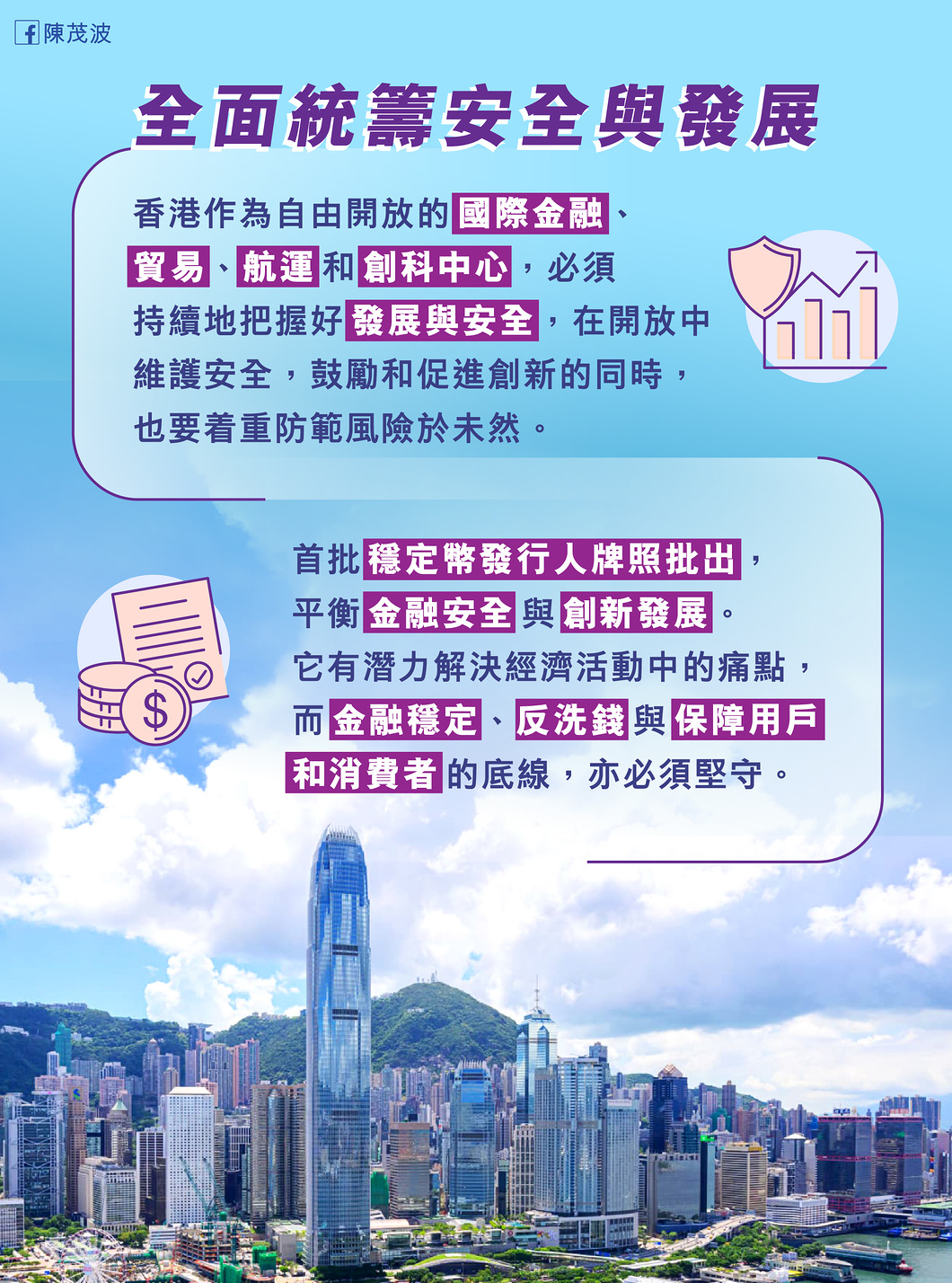
The 15th Five-Year Plan Outline identifies “Following a holistic approach to development and security” as one of the six guiding principles for advancing economic and social development during the 15th Five-Year Plan period. The same principle is also highlighted in the white paper Hong Kong: Safeguarding China’s National Security Under the Framework of One Country, Two Systems, published this February, as one of the six principles Hong Kong should follow in safeguarding national security. In practice, as a free and open international centre for finance, trade, shipping, and innovation and technology, Hong Kong must strike a proper balance between development and security. This means safeguarding security while remaining open, and, as we consolidate and strengthen our advantages and promote innovation, placing strong emphasis on preventing risks before they materialise.
Take the financial sector as an example. Hong Kong’s financial system has long been robust and efficient, supporting smooth market operations and strong growth. At the same time, we have consistently safeguarded stability by closely monitoring market conditions and interlinkages, and by maintaining strong buffers. The Linked Exchange Rate System provides a reliable anchor for monetary and financial stability. Banks’ capital adequacy and liquidity ratios are well above international standards, and securities brokers maintain adequate capital and orderly trading.
At the same time, we attach great importance to innovation. As the country advances high-quality development, Hong Kong has long served as both a “testing ground” and a “firewall” for reform and opening up. We support the Mainland in deepening capital market reforms, while guarding against the spillover of external risks. Only by pursuing innovation in a secure, well-controlled risk environment can we build a more resilient, dynamic and competitive financial system that is better able to withstand external shocks and sustain long-term growth.
The Hong Kong Monetary Authority (HKMA) recently granted the first batch of stablecoin issuer licences under the Stablecoins Ordinance, demonstrating how security can be balanced with innovation. The HKMA recognises that stablecoins have significant potential to address pain points in economic activity—especially in cross-border transactions and payments—while maintaining clear safeguards for financial stability, anti-money laundering, and user and consumer protection. To achieve this balance, the HKMA has adopted a prudent, phased approach to licensing, with a strong emphasis on issuers’ robust compliance capabilities.
Energy is another case in point. Geopolitical developments have disrupted global energy supplies, and some regions have even experienced shortages. By contrast, the country’s energy self-sufficiency rate has remained consistently at above 80% in recent years. The energy mix has also become more balanced. Non-fossil energy—such as hydropower, nuclear, wind and solar, as well as natural gas, now account for over 30% of total consumption, while oil accounts for less than 20%. In addition, import sources have become more diversified. This structure has strengthened the country’s resilience and its ability to absorb shocks amid volatility in global energy markets.
Stable energy supply is essential to people’s livelihoods and the smooth functioning of the economy. Around 80% of Hong Kong’s oil products are sourced from the Chinese Mainland. With the country’s steadfast support, Hong Kong’s energy supply has remained stable. In response to the latest supply and demand conditions, the HKSAR Government has set up an Inter-departmental Task Force on Monitoring Fuel Supply to closely track market developments. The task force has proposed four short-term measures, including diesel price subsidies, to support industries and livelihood services that have been significantly affected. The Legislative Council has swiftly approved the necessary funding, and we are expediting the implementation details.
Over the medium to long term, we must continue to drive the green transition of Hong Kong’s energy sector. This includes strengthening regional cooperation to steadily increase the use of zero-carbon energy, working towards the “net-zero electricity generation” target set out in the Hong Kong’s Climate Action Plan 2050, and improving the diversity and resilience of Hong Kong’s energy mix. The HKSAR Government plans to raise the share of zero-carbon energy in electricity generation to around 60–70% by 2035. With the Clean Energy Transmission System enhancement works expected to be completed within this year, Hong Kong will be able to progressively import more zero-carbon electricity.
In today’s fast-changing international environment, geopolitical competition is intensifying. Risks and challenges are present across various domains, from financial markets to energy supply. As circumstances continue to evolve, Hong Kong must place security at the heart of development, while strengthening the foundations of security through high-quality development. Only by pursuing development and security in a coordinated manner can Hong Kong seize new opportunities amid change and write a new chapter of greater prosperity, stability and momentum.
April 12, 2026