Blog
The Economy in the First Quarter of 2026
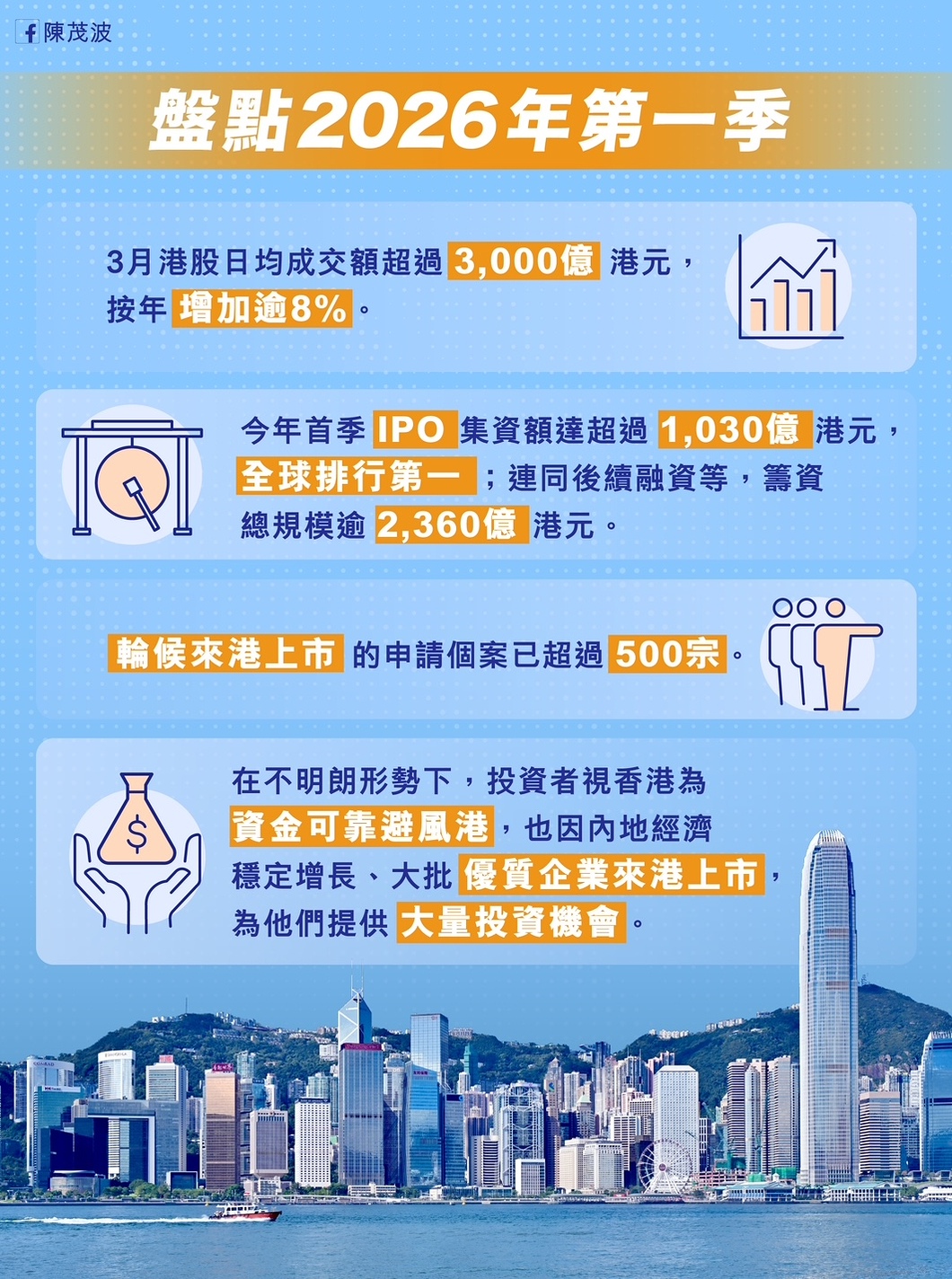
As the first quarter of 2026 passed, the global landscape remains complex and highly fluid. The conflicts in the Middle East continue to weigh on the market sentiment. This external backdrop has dragged on Hong Kong’s equity market: the Hang Seng Index is down around 2% year to date. Even so, trading has remained active. The average daily turnover in the first two months exceeded HK$260 billion, up 17% year on year. Entering March, market activities strengthened further, with average daily turnover surpassing HK$300 billion—more than 8% higher than the same period last year. The increased asset allocations to Hong Kong by investors amid heightened uncertainty suggests that they not only view the city as a reliable safe haven for capital, but are also encouraged by the abundant investment opportunities created by the steady growth in the Mainland's economy and a strong pipeline of quality companies choosing to list in Hong Kong.
Meanwhile, global competition in frontier technologies such as artificial intelligence has heated up. Breakthroughs in core technologies, the development of upstream and downstream segments of the industrial chain, and the exploration of broader application scenarios all require substantial capital support. Whether these companies and industries have smooth, stable, sustained and efficient access to financing is therefore critical. Hong Kong’s listing platform is playing a pivotal role in this regard—supporting the nation’s technological advancement and establishment of a modernised industrial system while also attracting global capital into these future-oriented sectors.
|
Taking initial public offerings (IPOs) as an example, Hong Kong’s IPO market maintained the strong momentum from last year in the first quarter. As of March 27, fundraising had exceeded HK$103 billion, ranking first globally. Taking into account other funds raised including through follow-on fundraising, the total amount of funds raised reached approximately HK$237 billion. More importantly, more companies listing in Hong Kong now come from emerging industries—AI, semiconductors, robotics, autonomous driving, biotech, and more. Applications currently in the pipeline for listing in Hong Kong have already surpassed 500 cases. In other words, the more uncertain the external environment becomes, the more companies see Hong Kong as a key gateway for fundraising and overseas expansion.
Hong Kong’s financial markets have long contributed to the country’s reform, opening-up and economic development. Through the “Finance+” strategy, we are supporting the development of new quality productive forces and actively contributing to the building of a modernised industrial system in our country. Recently, Hong Kong was once again affirmed as one of the world’s top three international financial centres, with a rating closely trailing the top two—New York and London. This underscores that the Mainland’s continued economic growth and the country’s strong support for Hong Kong provide the firmest foundation for Hong Kong’s status as an international financial centre.
The financial markets have performed well, and Hong Kong’s real economy also showed general improvement in the first quarter, with some areas recording notable results.
On the export front, supported by a recovery in global demand for electronic products and the reconfiguration of regional production and supply chains, merchandise exports rose by nearly 30% year on year in value terms in the first two months, demonstrating a remarkable performance. This indicates that despite uncertainties in the external trade environment, Hong Kong’s role as a trade hub remains solid.
While many residents are travelling abroad these days with the Easter long holiday underway, the overall trend suggests that the foundation for recovery in the retail sector has become increasingly evident. In the first two months of the year, total retail sales value rose by 11.8% year on year, marking the tenth consecutive month of growth and accelerating from the growth in the fourth quarter of last year. The increase was not limited to high-end spending, but also seen in livelihood-related categories such as furniture and clothing, indicating that local consumer confidence is steadily strengthening.
Online sales have also been buoyant, surging by 27.5% year on year in the first two months. This shift in consumption patterns promotes the development of supporting digital industries such as e-payments, logistics, and data analytics, etc., injecting new impetus into the retail ecosystem.
The labour market has remained stable, with the unemployment rate edging down to 3.8%. Unemployment situation in the retail and food and beverage service activities sectors has improved, and overall employment earnings have continued to rise. This, along with the improving sentiment in both the stock market and the residential property market, renders support to local consumption.
April 5, 2026