Blog
Striding Confidently into the New Year
2025 is about to come to an end. Looking back on the year, we overcame quite a number of challenges. Despite external uncertainties, the local asset markets continued to improve, capital kept flowing in, the number of visitor arrivals increased, overall exports and fixed capital investment performed well, and local consumption showed signs of stabilisation. It is estimated that Hong Kong’s economic growth this year will accelerate to 3.2%, slightly higher than the forecast made at the beginning of the year. Overall, strong performances in exports and investment have been the main engines of economic growth. At the same time, both the stock and residential property markets saw increases in price and volume, further reinforcing the market’s positive expectations.
On asset markets, Hong Kong stocks performed strongly, rising for the second consecutive year. As of last week, the Hang Seng Index closed at 25,818 points, up by about 29% from the end of last year. In terms of gains, this is set to be the best year since 2017, and the performance ranks among the top of the world’s major stock markets. This rally has been supported by active trading. Funds raised through initial public offerings (IPOs) more than doubled year-on-year; both market turnover and post-listing follow-on fundraising rose by about onefold year-on-year. In the first 11 months of 2025, the average daily turnover in the Hong Kong stock market was close to HK$260 billion. By mid-December, IPO fundraising ranked first in the world – exceeding HK$270 billion, with four listings among the global top ten this year. Over the same period, follow-on fundraising by listed companies exceeded HK$510 billion. For asset and wealth management, in the first nine months of the year, net inflows into SFC-authorised funds domiciled in Hong Kong exceeded US$41 billion, more than 1.5 times last year’s full-year figure.
The residential property market has also become active. In the first 11 months of the year, transactions were close to 57,000, up about 16% year-on-year, marking the second consecutive year of increase. Residential property prices rose by about 3% cumulatively, and rents rose by about 4%. Overall, the market holds a positive outlook for the residential sector. Sentiment in the office market has also improved: transaction volume in the first ten months of 2025 increased by 74% compared with the same period last year, and Grade A office vacancy rates had edged down slightly.
In fact, Hong Kong’s economy has maintained growth momentum for a third consecutive year, and the three drivers of the economy all delivered solid performances. Exports grew markedly in the first three quarters and remained a major contributor to growth. Fixed capital investment rose by 2.5% in the first three quarters; in the third quarter alone, the increase was 4.3%, the best in four quarters. This was mainly supported by a significant rise in investment in machinery, electronic equipment, software and other equipment, and intellectual property products, plausibly reflecting businesses’ growing focus on automation, digitalisation and data-driven transformation. Private consumption also benefited from the recovery in asset markets and improved overall sentiment, rising by 0.9% in the first three quarters, reversing the decline seen in the same period last year.
|
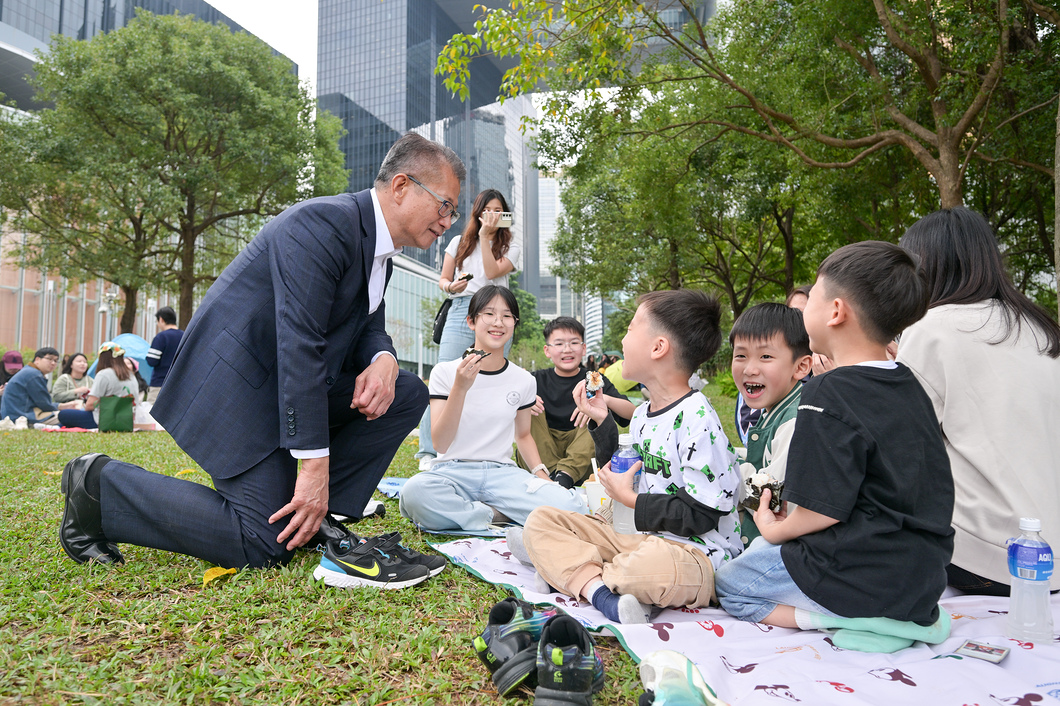
| Earlier, on Christmas Eve, I visited Tamar Park to engage in casual conversations with members of the public. |

|
| Earlier, on Christmas Eve, I visited Tamar Park to engage in casual conversations with members of the public. |
Looking ahead to next year, Hong Kong’s economy is expected to maintain positive momentum. While the market generally expects the global economy to maintain a moderate, albeit slower, expansion, the Chinese Mainland and Asia as a whole will remain major growth engines, providing important support to our economy. In addition, expectations of interest rate cuts across major markets will likely boost business and investment sentiment.
More importantly, 2026 marks the first year of the country’s 15th Five-Year Plan. We will more proactively align with national development strategies, with finance, innovation and technology, and trade serving as Hong Kong’s three key engines of development.
|
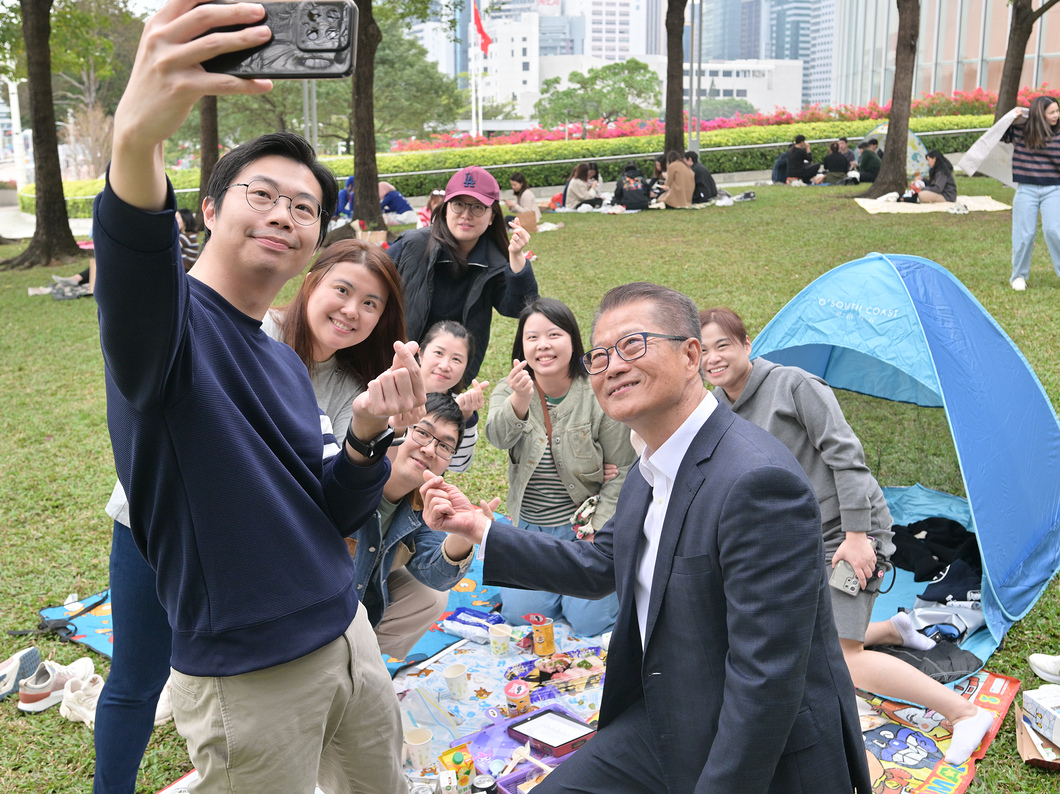
| Earlier, on Christmas Eve, I visited Tamar Park to engage in casual conversations with members of the public. |
First, we will work to comprehensively enhance Hong Kong’s functions and substance as an international financial centre. This includes strengthening our advantages in the financial markets by enhancing the competitiveness of the stock market and attracting more high-quality companies – from Southeast Asia, the Middle East, the Global South and beyond – to list in Hong Kong. At the same time, we will diversify our financial offerings by accelerating the development of fixed income and currency markets, green finance, fintech, etc., while actively pursuing new opportunities, including commodities trading and international gold trading. Furthermore, the Renminbi (RMB)’s role in global cross-border trade and investment is increasing. Hong Kong, as the offshore RMB business hub, will continue to support the prudent advancement of RMB internationalisation in three aspects: enhancing offshore RMB liquidity, improving relevant financial infrastructure, and expanding the range of investment products and risk management tools.
Second, we will accelerate the development of a world-class innovation and technology (I&T) hub, particularly through close collaboration with sister cities in the Guangdong-Hong Kong-Macao Greater Bay Area. Globally, breakthroughs in artificial intelligence (AI) and biomedicine technology are major focal points for the investment community. Hong Kong must fully leverage its strengths and strive to take a leading role in this wave of innovation-led development. AI will define the core competitiveness of economies in the future and reshape the global economic landscape. We are accelerating efforts to develop AI as a core industry in Hong Kong and to empower the upgrading and transformation of traditional industries through an “AI+” strategy. We will advance AI development across six dimensions: computing power, algorithms, data, application development, funding support and talent cultivation. In biomedicine, Hong Kong’s advantages are even more pronounced. We will continue to attract more world-class pharmaceutical companies and medical research institutions to establish a presence in Hong Kong, and we will introduce the “primary evaluation” registration mechanism for drugs and medical devices, thereby solidifying Hong Kong’s position as a regional hub for medical research and development.
Third, we will enhance Hong Kong’s functions as an international trade centre. In response to a new global economic and trade landscape and the ongoing reshaping of industrial and supply chains, Hong Kong will continue to perform its role as a “super-connector” and “super value-adder.” The country encourages Mainland enterprises to go global and participate more deeply in international industrial division of labour and collaboration. Hong Kong is actively building itself as a multinational supply chain management and trade financing hub. We will provide Mainland enterprises intending to go global with services such as supply chain management, trade financing, treasury management, professional services, compliance consultancy and corporate training. To facilitate this, we have established a GoGlobal Taskforce, bringing together resources from both the public and private sectors to provide more comprehensive support for these companies.
Building upon the good foundation laid in 2025, we are about to enter a new year. While new challenges are inevitable, greater opportunities will also arise. In the course of better integrating into and serving the country’s overall development agenda, Hong Kong will also achieve better progress, creating more high-quality jobs and allowing the benefits of economic growth and diversification to benefit the community more broadly. At the same time, we will maintain a high degree of vigilance. Given the persistent uncertainties in the external environment, we will guard against “black swan” and “grey rhino” risks, and carefully balance the dual priorities of security and development. This will allow Hong Kong to continue moving forward steadily on both the social and economic fronts in 2026.
December 28, 2025