Blog
Enhancing Quality of Life and Competitiveness through Continuous Improvement of Transport Infrastructure
The Central Kowloon Bypass (Yau Ma Tei section), which runs across East and West Kowloon, officially opened to traffic this morning. Vehicles travelling between Yau Ma Tei and Kai Tak can now use this direct route, bypassing the previously busy urban road sections between the two districts. During peak hours, travel time can be greatly reduced from 30 minutes to about 5 minutes. Starting tomorrow, the first working day after the opening, 8 bus routes will utilise this bypass, saving up to 50 minutes of travel time per day (round trip) for commuters travelling across districts.
When the other section of the bypass — the "Kowloon Bay Section" — is completed next year, the entire new route will form Route 6, together with the Tseung Kwan O–Lam Tin Tunnel, to become the third major trunk road crossing Kowloon. Travel time between Tseung Kwan O and Yau Ma Tei will then be significantly reduced from currently around 65 minutes to about 12 minutes.
|
The Central Kowloon Bypass (Yau Ma Tei Section) spans 4.7 km in total, with over 80% (3.9 km) consisting of underground tunnels that run underneath 240 buildings. To avoid underground foundations, the excavation of the project reached depths up to 150 metres below ground level. 2,400 blasting operations were carried out without affecting daily operations on the surface or the safety of other underground utilities. To take forward the project, facilities such as the Jade Bazaar in Yau Ma Tei and several community services, including a maternal and child health centre and a public library, had to be reprovisioned. From planning and design to local consultation and construction, this massive infrastructure project faced many challenges throughout its journey. Given the densely populated, complex construction environment and numerous constraints, public support and cooperation were crucial. Through the planning of this project, the community environment has also been beautified, with more green open space provided. This includes the on-going construction of a landscape deck of over 30,000 square metres near the tunnel's western entrance in Yau Ma Tei, providing more public green space.
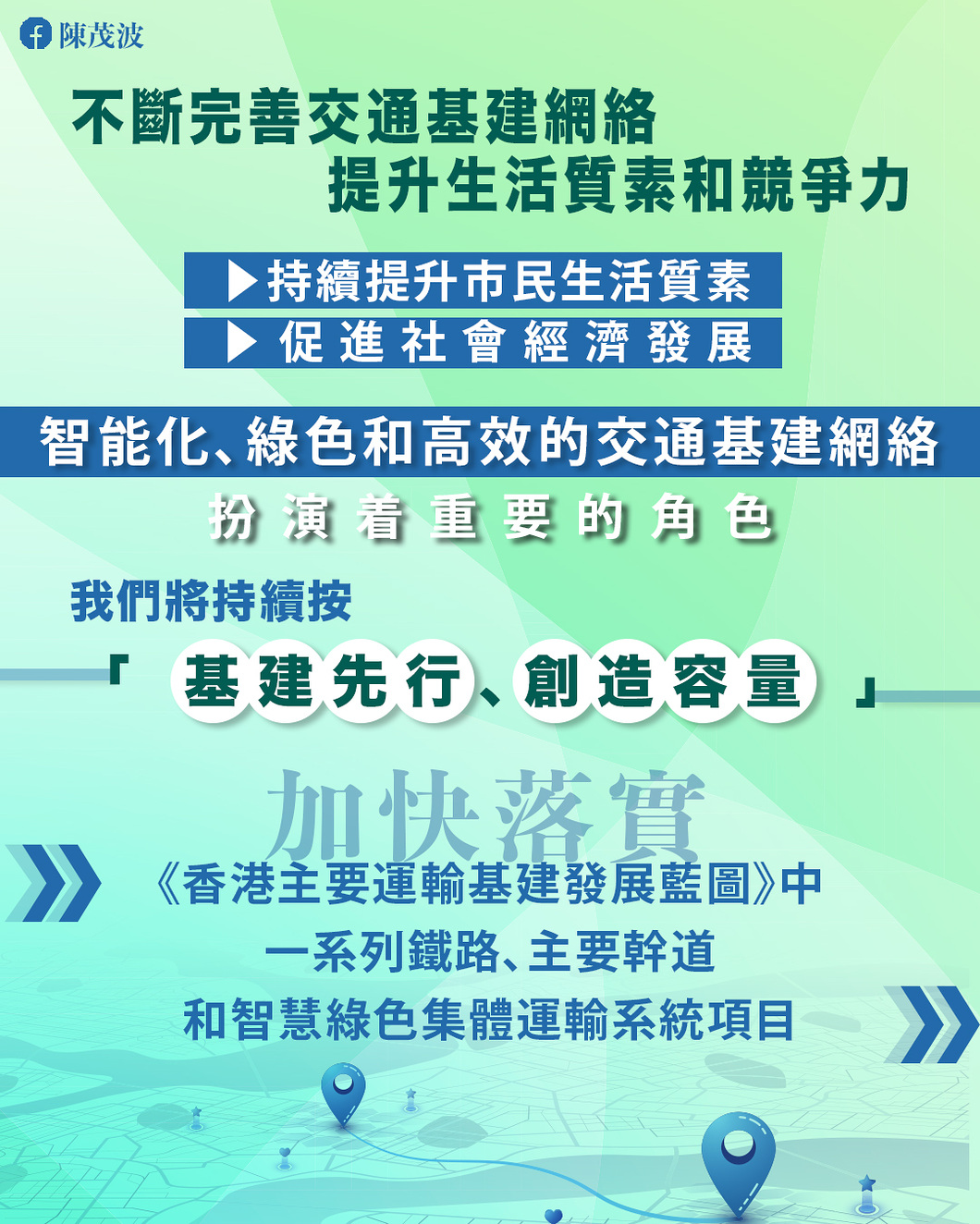
Smart, green, and efficient transportation infrastructure plays a vital role in improving residents' quality of life and promoting social and economic development. It also enhances Hong Kong's overall competitiveness, including strengthening economic integration with Chinese Mainland, especially within the Guangdong-Hong Kong-Macao Greater Bay Area — a key element in aligning with national development strategies.
In 2025, the British magazine "Time Out" conducted an index survey where locals rated their city's public transport, including buses, trains, and trams. Hong Kong's public transport system ranked first in the world. In the Urban Mobility Readiness Index 2024, developed by an international consulting firm and an American university, Hong Kong's public transport system ranked second among a number of global cities, while our green transport system ranked first in Asia. Many visitors and locals who have travelled abroad also praised the efficiency and convenience of Hong Kong's transit system. In fact, reports including the World Competitiveness Yearbook and Global Financial Centres Index also consider transport network an essential factor in assessing competitiveness.
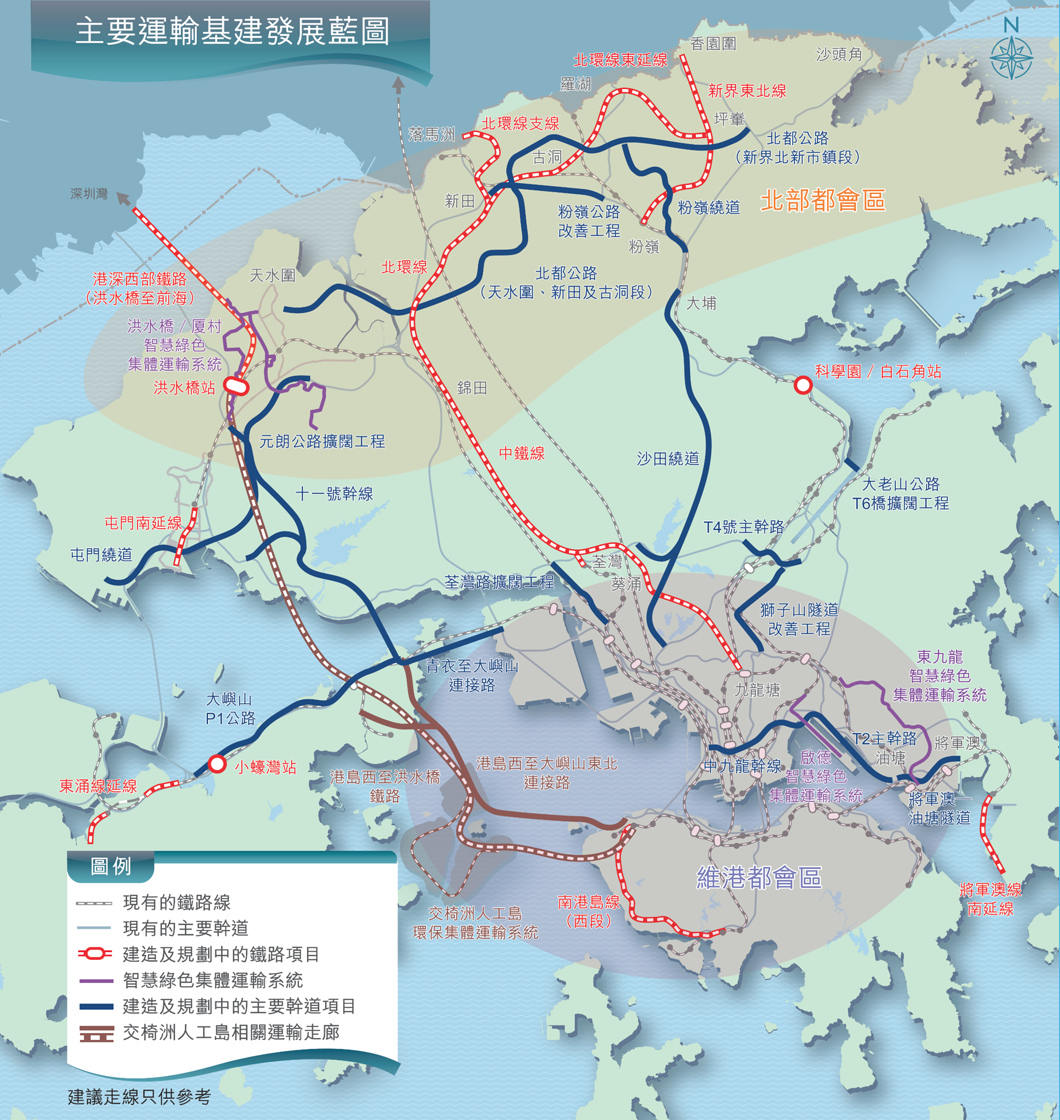
We will continue to adopt the principles of "infrastructure-led" and "capacity-creating" to accelerate the implementation of projects outlined in the Hong Kong Major Transport Infrastructure Development Blueprint, including new railway lines, major highways, as well as smart and green mass transit systems.
|
| Hong Kong Major Transport Infrastructure Development Blueprint |
In terms of road network, key projects in the coming years include the remaining section of Route 6, the Trunk Road T4 in Sha Tin and the Northern Metropolis Highway. With the completion of these major highways, the total length of trunk roads is expected to increase by 46%, from the current about 260 km to nearly 380 km.
In terms of railway network, we are pressing ahead with projects such as the Tung Chung Line Extension, Oyster Bay Station, Tuen Mun South Extension, Kwu Tung Station, and Hung Shui Kiu Station. They are expected to be completed progressively from 2027 onwards. Detailed planning and design of the South Island Line (West) also commenced this month, aiming for commissioning by 2034 or earlier. The construction of the Northern Link Main Line will be implemented together with the Spur Line, with a view to advancing the simultaneous commissioning by 2034 or earlier. Upon the progressive completion of these railway projects, the total length of Hong Kong's railway network will increase by 44%, from currently about 270 km to nearly 390 km.
During the period of the 15th Five-Year Plan, Hong Kong will continue to actively integrate into and contribute to the national development agenda. The Greater Bay Area is a major national development strategy in this new era, and deeper integration of transportation infrastructure with neighbouring cities will facilitate more efficient flow of key production elements, including people and goods. In this connection, apart from the Northern Link Spur Line, we are also pressing ahead with the Hong Kong–Shenzhen Western Rail Link (Hung Shui Kiu to Qianhai) (HSWRL), striving for completion of the construction works in 2034, followed by integrated testing and commissioning to realise the goal of commissioning both the Hong Kong and Shenzhen sections of HSWRL in 2035. This will further promote economic and high-end services collaboration between the two cities.
Beyond hardware, smarter and greener transport software — including the use of advanced technology to improve efficiency and digital management — will enable more precise and effective transport systems and offer a better user experience. Our upcoming Transport Strategy Blueprint will embrace the vision of "Implementing a People-centric Approach, Strengthening Connectivity with Both the Mainland and the World, Promoting Efficient Travel, and Embracing a Green Lifestyle". It will highlight areas such as the application of technology and AI, promotion of autonomous vehicles, smart motorway management, improved public transport efficiency, and stronger integration with the Greater Bay Area. These efforts will make Hong Kong's transport network and urban management more intelligent, continuously improving residents' quality of life and travel convenience — and enhancing our city's overall competitiveness.
December 21, 2025