Blog
Deepening Reforms for a Brighter Future
Last week, the Chief Executive delivered his Policy Address, outlining a series of solid initiatives focused on two fronts: driving economic development and improving people’s livelihood. With a forward-looking vision, the Policy Address aims to accelerate Hong Kong’s economic growth and strengthen its momentum of development, while advancing progress through reforms and shaping the future through innovation. The Policy Address has drawn wide attention from the community, with various sectors broadly recognising the need for Hong Kong to fast-track the transformation of industries and enhance its economic vitality.
To accelerate economic growth, the Policy Address sets out strategic plans to leverage Hong Kong’s unique strengths by reinforcing traditional industries while fostering the development of emerging sectors. On the one hand, for example, it aims to solidify Hong Kong’s status as an international financial centre by enhancing the related infrastructure and overall competitiveness. On the other hand, the Policy Address places a strong emphasis on nurturing emerging industries, especially by harnessing the rapid advancement and broad application of artificial intelligence (AI) in innovation and technology (I&T). The Policy Address also highlights the need to accelerate the development of the Northern Metropolis development through optimising the top-level governance structure, driving institutional innovation, and implementing a comprehensive strategic blueprint. These efforts are designed to better accommodate I&T enterprises in Hong Kong, promote industrial transformation, and inject fresh momentum into Hong Kong’s economic development.
|
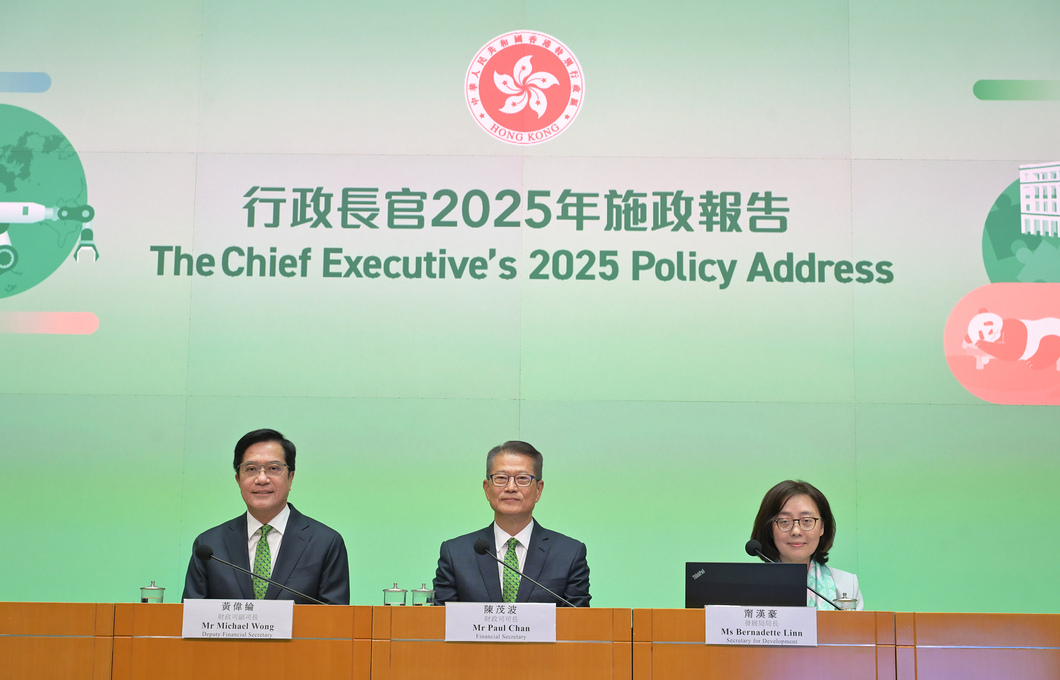
| Following the Chief Executive’s delivery of the Policy Address last Wednesday, the team of Principal Officials attended several press conferences to elaborate on the relevant initiatives. |
The Northern Metropolis is a key driver of Hong Kong’s industrial restructuring, and the vehicle to better realise the synergistic development of financial services, I&T and trade. According to the Policy Address, the Chief Executive will chair the Committee on Development of the Northern Metropolis, under which three working groups have been established. They include the Working Group on Devising Development and Operation Models, led by me; the Working Group on Planning and Construction of the University Town, led by the Chief Secretary for Administration; and the Working Group on Planning and Development, led by the Deputy Financial Secretary.
The three working groups have distinct focuses. The two working groups led by the Chief Secretary and myself respectively are primarily tasked with driving the development of specific industries; while the working group led by the Deputy Financial Secretary will coordinate the efforts of various policy bureaux and departments – including those overseeing planning, works, transport, environmental protection and housing – to ensure that land and supporting infrastructure will be made available in a timely manner to tie in with the landing of industries. At the heart of this approach is having clear targets and flexible approaches. For clear targets, we mean linking the development of the Northern Metropolis with strategic industries, and this will serve as a guiding objective for all related work. Flexible approaches involve exploring innovative, flexible and pragmatic options across various aspects, such as legal frameworks, administrative procedures and financing models, with a view to expediting the development of the Northern Metropolis and associated industries.
The Working Group on Devising Development and Operation Models will hold its first meeting this month. The goal of this working group is to design development and operational models based on the nature and scale of the designated development areas in the Northern Metropolis. This includes setting up one or more dedicated companies, or statutory or non-statutory bodies, for various industrial parks, and devising appropriate public-private partnership approaches. It will also introduce a shift in land tendering from "highest bidder wins" to industry-linked "two-envelope approach".
The "two-envelope approach" differs from the traditional "highest bidder wins" approach in land tendering. It requires bidding enterprises to submit technical proposals and development plans, allowing the Government to comprehensively consider both the investment and technology that can be brought by the enterprises; their facilitation of mid- and downstream industries; economic and tax contributions; job creation; as well as the overall strategic planning of the Northern Metropolis. This is an important means for the Northern Metropolis to become "industry-linked".
Furthermore, considering the substantial financial investments required by the Government and enterprises when developing large-scale industries, the working group will design various financing options. These will include different types of equity, bonds, market financing, public-private partnership models, as well as government injections and provision of land as a form of capital participation. For example, in the case of provision of land as a form of capital participation, one approach is to establish a company for individual projects, with the Government injecting land while the enterprise would be responsible for funding, construction and operation, thereby carrying out the development together. The target is to fully leverage market resources to accelerate land development and project advancement, while alleviating the financial burden on the Government for advanced works such as site formation and infrastructure engineering.
|
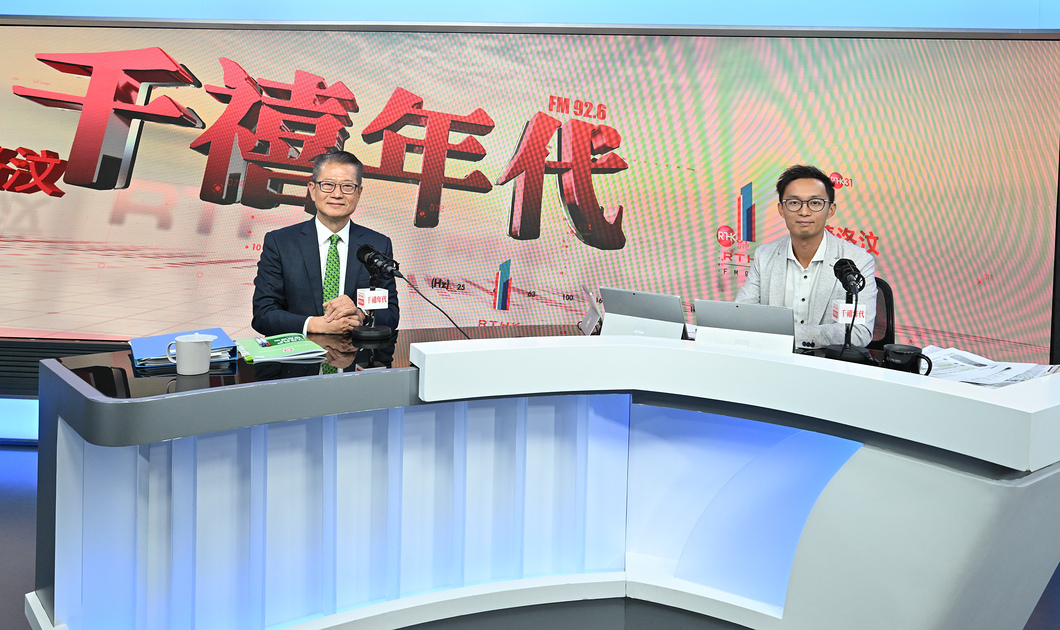
| Attending a radio programme last Friday to explain the relevant initiatives in the Policy Address. |
To accelerate the institutional development and infrastructure advancement of the Northern Metropolis, we plan to introduce a dedicated legislation that, through appropriate authorisation, will expedite decision-making, enhance efficiency and simplify statutory procedures. This includes speeding up the approval of building plans, relaxing planning restrictions, handling land compensation more flexibly, and better managing the cross-boundary flow of production factors.
Another key point in the Policy Address is the formulation of "preferential policy packages" to enrich our toolbox for attracting investments. In today’s highly competitive global landscape, the race to attract high-quality, leading enterprises is intense. Many neighbouring economies are actively deploying preferential policies to strengthen their own competitive edge. In Hong Kong’s case, building on our simple and low tax regime, we will adopt a flexible approach through policy innovation. Depending on the specific merits of each case, we will consider applying targeted measures from the preferential policy packages – such as land allocation, concessional land premiums, tax incentives, priority access to government procurement, talent admission schemes, and even subsidies. When assessing individual cases, key considerations will include the potential economic benefits to Hong Kong, the enterprise’s contribution to industrial upgrading and transformation, job creation and the prospects for future tax revenue.
During the process, InvestHK and the Office for Attracting Strategic Enterprises (OASES) will engage in negotiations with the relevant enterprises, conduct due diligence, and secure support from the appropriate policy bureaux before submitting their recommendations to me for a final decision.
The Policy Address also proposed a number of concrete measures to further support industrial development, including initiatives to advance the AI and life and health technology sectors – both of which align closely with the development of the Northern Metropolis. OASES will soon announce a new batch of strategic enterprises, including several world-class pharmaceutical companies. Their decision to establish a presence and invest in Hong Kong is a strong vote of confidence in the city’s future development.
There is broad consensus across the community that accelerating the development of the Northern Metropolis is essential to diversifying Hong Kong’s industrial structure. The Northern Metropolis plays a pivotal role not only in strengthening Hong Kong’s core competitiveness, but also in creating quality employment opportunities for our future generations. Let us stay focused on our goals and act with a sense of urgency—there is no time to lose. Together, we can drive Hong Kong toward better development, with brighter career prospects for our people, and a more fulfilling life for all.
September 21, 2025